
G Henle Verlag
If you’ve ever stepped into a music conservatoire, a piano teaching studio, or even just browsed sheet music online, you’ve definitely seen it. That distinct, elegant shade of darkish pastel blue which forms the iconic cover belonging to G. Henle Verlag publications. Henle is a German music publisher who has spent the last 75 years becoming the gold standard for classical musicians worldwide. Founded back in 1948 by a diplomat and passionate pianist named Günter Henle, this boutique Munich-based publisher has a massive global impact, exporting over 80% of its catalogue to musicians everywhere from the US to Japan.
What makes Henle scores a favourite with professionals, teachers and music students alike really comes down to their unmatched dedication to historical accuracy and premium quality. Henle employs a team of PhD musicologists who forage far and wide discovering original manuscripts, first prints, and a composer’s personal handwritten notes. Their goal is to give the musician a true Urtext—meaning an original text score that shows exactly what the composer actually wrote.
Until 1999, Henle hand-engraved their scores onto metal plates. Today, they are still printed sustainably in Bavaria, Germany, on high-grade rich cream paper designed specifically to lay flat on a music stand. They even include a handy one-to-nine difficulty rating on their works, which has been extremely helpful for music students and teachers looking to gauge a piece’s level of difficulty before diving in.
While the publisher is deeply rooted in tradition, focusing mostly on renowned works and their composers generally from around the Baroque era to early 20th-century classical modernism, they certainly aren’t stuck in the past. The Henle Library App has successfully brought them into the digital age, letting musicians load their entire catalogue onto a tablet, toggle between different historical fingerings, and annotate their music digitally.
The Collection
As a young student, my piano desk was adorned with Henle’s pastel blue scores. Like many musicians and piano teachers, I have all the Beethoven Sonatas (in hardback as well as the soft cover versions!), all Mozart’s sonatas, a lot of Liszt as well as numerous other works in Henle’s fine Urtext editions. Fast-forwarding many years, it’s now a real privilege to be working with the Henle team: it’s really like a dream come true for me.
I’ve been collaborating with Henle for the past five years, serving as an adjudicator, or judge, for their yearly children’s piano competition, which has been a lot of fun. But now, alongside this role, I’m working with them to create a new series of educational piano books focusing mainly on studies or études (piano exercises). Our first foray into the ‘study’ realm begins with one of the most popular collections ever written for the intermediate level pianist: 25 Etudes Op. 100 by German Romantic composer Friedrich Burgmüller (1806–1874). Published just last month, this volume signifies the start of an exciting project.
These little piano pieces are loved by teachers and students alike, and can be frequently found on piano exam syllabuses too. Their charming descriptive, or programmatic, titles make them firm favourites, requiring a colourful imagination coupled with the obvious technical skill necessary for a successful performance. There are already many excellent editions of this collection, but this one, as might be expected from Henle, is definitely special and contains several unique features that set it apart.
B. Schott’s Söhne Historical Archive,
Bayerische Staatsbibliothek,
Shelfmark Mus.Schott.As 73-1
New Discoveries and a New Layout
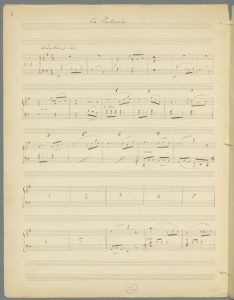
Dr Andreas Pernpeintner, editor of this edition, spent considerable time studying the composer’s original manuscripts and discovered several previously unknown ‘versions’ of five of the studies within this set. Therefore, our new edition includes these historically expanded musical variations that Burgmüller noted down after the first print run: they are printed at the back of the volume in the Appendix. The noted difference between these re-written versions and those we have come to know and love, make for interesting study. Pernpeintner has written a fascinating and very informative article about his work on this score which is published on the Henle blog, and you can read it by clicking on the link below:
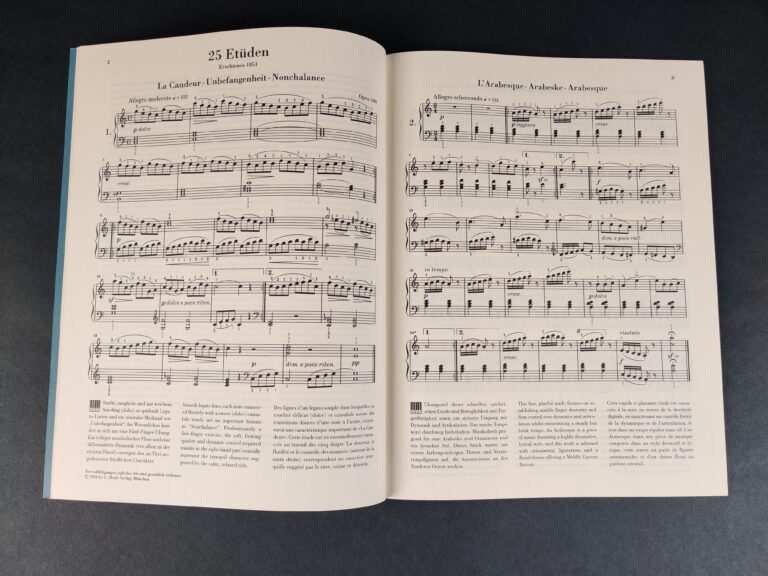
My role in this book was twofold. Firstly, I’ve provided performance commentaries for every piece. These clarify the technical challenges and marry them up with the musical considerations and interpretative qualities expected for a satisfying performance. These commentaries have been printed on the same page as the musical score (a new departure for Henle) and appear in German, English and French. Secondly, I have provided fingerings for each piece. Whilst Urtext editions nearly always employ the composer’s own fingerings (which is what we have done here), Henle have implemented an innovative two-tone fingering system, where the composer’s original fingerings are printed in black ink, while modern additions, made by me, are subtly overlaid in grey, so musicians can tell them apart instantly. Fingering is always a moot point as everyone’s hand is different, so my grey-coloured fingerings are, of course, merely suggestions.
I have thoroughly enjoyed working on these beautiful pieces. Below I’ve linked my performance of possibly the loveliest work in the set, Ave Maria (No. 19). We really hope you enjoy discovering this new edition.

A beautiful rendition of both the score and the performance.
Thank you so much, Barbara! I really value your support. Melanie 🙂