
Katharina Nohl is a German-born Swiss composer passionately devoted to highlighting the work of female composers through her international cultural work and her music festival, the Swiss Female Composers Festival. I’m excited to be a featured composer at the 2026 SFCF which is to be held on the 24th and 25th of October in Zurich.
I caught up with Katharina over the summer for a ‘Coffee with Composers’ interview which forms the second post in this new series. Katharina talks here about her background, influences, and inspirations as well as current and future work.
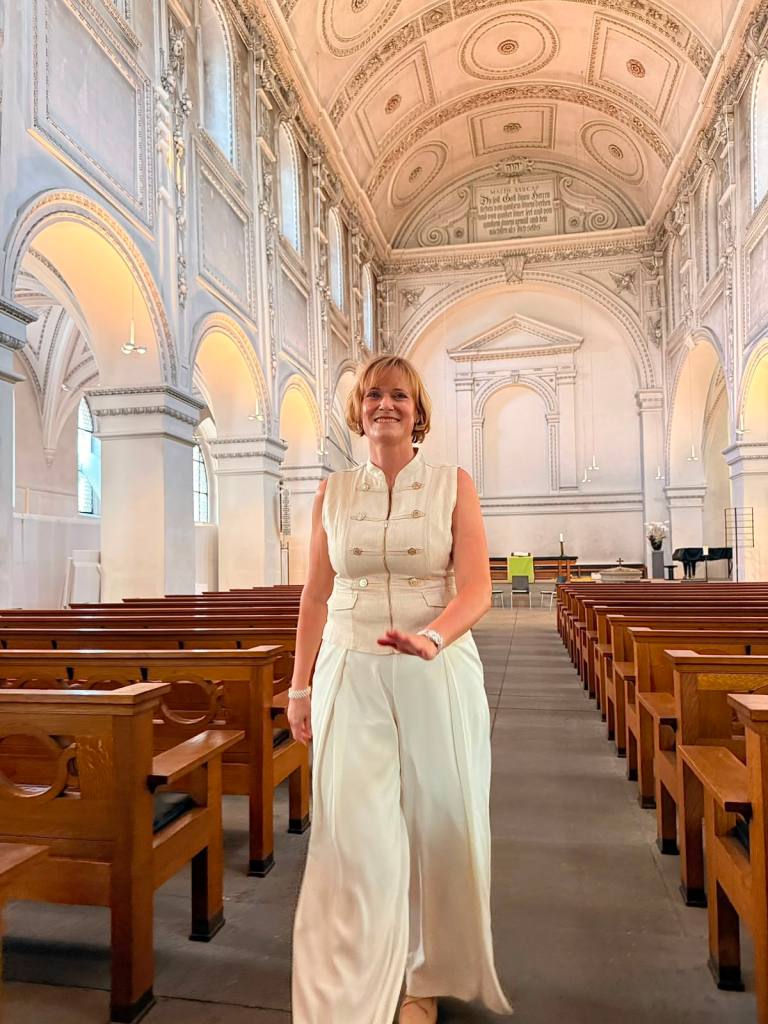
- You have built a dynamic career as a composer, performer, and festival director. What initially drew you to the world of classical music, and how has your creative voice evolved over time?
My relationship with music began at an early age under a piano teacher who introduced me to a wide variety of styles and cultural backgrounds, while noting my natural affinity for modern repertoire. As I developed as a musician, I found myself constantly intrigued by overlooked works, hidden gems, and the music of unknown composers—pieces that possessed extraordinary beauty but had simply been passed over. That curiosity shaped both my voice as a composer and my mission as a cultural advocate. Today, my compositions lean into modern colours, expressive tonality, and strong narrative arcs, while my work as a festival director and publisher centres on giving overlooked, high-quality music the platform and visibility it truly deserves.
- How did your musical training at Southampton University, and elsewhere in Europe, shape you as a composer? Did you study with any particularly influential teachers?
Moving between different countries and studying in varied cultural environments naturally opened my perspective on how diverse musical traditions approach expression. My time in the UK at Southampton University provided a wonderfully broad, open-minded atmosphere that encouraged stylistic individuality, beautifully complementing the rigorous structural traditions of mainland Europe. Experiencing these distinct artistic worlds taught me to navigate different musical landscapes with versatility. A defining turning point came when I received direct encouragement from Fazıl Say, whose feedback was a major catalyst in giving me the confidence to pursue composition seriously. Ultimately, learning from diverse mentors reinforced my belief that technical craft should always serve authentic emotional expression, free from rigid or narrow boundaries.
- How has your performing career as a pianist influenced your composing?
Being an active pianist is central to how I compose. Sitting at the instrument gives me a physical, tactile understanding of sound, resonance, and playability. Because I play various instruments myself and regularly perform alongside other musicians, my internal palette naturally expands beyond the keyboard—it allows me to imagine how different colours, sustained acoustic spaces, and instrumental timbres interact. Performing keeps me grounded in the live experience, reminding me that a score isn’t just marks on paper; it is a physical, shared invitation for performers to bring a moment to life.
- You specifically mention the inclusion of various cultures and cultural influences in your music: how does this juxtaposition of differing elements manifest in your style?
For me, cultural influences in music are about bringing different rhythmic energies, modal colours, and narrative traditions into a cohesive modern classical language. I enjoy placing contrasting textures side-by-side—combining crystalline, structured classical lines with warm, expressive, or folk-inspired depth. Ultimately, culture and tradition express themselves through many facets of life. Just like food, which is so essential to human gathering and identity, music reveals how a culture balances contrast, nuance, and flavour. Exploring these elements gives you a deeper understanding of how different traditions can harmoniously coexist.
- In 2002, you moved to Switzerland, where you currently live near Zurich. Has living in central Europe played a part in your stylistic and overall development as a composer and musician, and how do you find suitable performing opportunities there to promote your work?
Having lived in various places across Europe—north, south, east, and west—I’ve experienced firsthand how each region carries its own distinct music, culture, and culinary traditions. Immersing myself in these diverse environments deeply enriched my perspective before settling in Switzerland. Here in central Europe, surrounded by breathtaking landscapes and a vibrant cultural crossroads, that varied background finds a natural home. Switzerland offers a rich chamber music tradition and an audience with a deep appreciation for culture. Finding suitable performing opportunities comes down to active initiative: establishing curated concert series, collaborating with like-minded chamber partners, and building direct bridges to audiences who value expressive, communicative contemporary music.
- You are the Founder and Artistic Director of the Swiss Female Composers Festival, an organisation set up to promote music written by women. Tell us how this came about and a little about its development? How do you see this festival expanding in the future?
Unlike most musicians, I actually grew up with music written by women composers around me—to me, their presence was completely normal. It was only as I moved across different European countries and navigated the wider professional landscape that I realized just how rare this experience was, and how underrepresented female creators remain on concert stages and in published scores.
That contrast inspired me to create the festival: I wanted to share the reality I grew up with and build a dedicated, high-profile platform where this repertoire is performed, recorded, and published. I am constantly expanding my network—building bridges with artists, institutions, and partners—which naturally drives growing awareness, interest, and meaningful international collaboration. Looking ahead, our vision is to deepen these connections globally through exchange programs and score distribution, helping to ensure these works become natural, permanent fixtures in the standard repertoire.
- You have compiled and edited several anthologies of music written by contemporary Swiss female composers, published by Universal Edition. What musical styles can we expect to find within these books?
Working with Universal Edition on these anthologies has been an immensely rewarding journey. The collections reflect a wonderful variety of backgrounds, with composers drawing inspiration from deep-rooted traditions as well as experiences of migration and cultural exchange. Stylistically, the music is genuinely audience-oriented: it focuses on strong expressive character, immediate communicative power, and physical playability. These are pieces written with real craft and warmth—music that invites performers into the score and leaves listeners with that immediate desire to hear it again.
- Contemporary classical music is often perceived as abstract or challenging for general audiences. What is your perspective on tonality and accessibility in your own compositions?
For me, accessibility is never about simplifying a musical idea—it is about clarity of communication. I believe in writing pieces that speak directly to both performer and listener, drawing on modern colours, contrasting textures, and rich modal harmonies while staying grounded in expressive tonality. I want a listener to feel invited into the piece from the first measure, experiencing tension, narrative, and emotional release. Above all, music needs to live, breathe, and be performed; it should never be composed merely to sit on a bookshelf, gathered in dust and never picked up again. It should be a living score that people want to return to time and again.
- Looking back at your career so far, what are some of the performance milestones or musical achievements that you are most proud of?
There are several major milestones I cherish—from establishing the Swiss Female Composers Festival to publishing my scores with Universal Edition and releasing albums. Yet, some of the most profound moments have been deeply personal collaborations with my family. Watching my daughter perform ‘By the Baltic Sea’ on stage at Carnegie Hall last year was an unforgettable experience, seeing my music brought to life in such an iconic setting. Equal to that was traveling to Turkey with my other daughter to create a high-end cinematic video for ‘Crystal’, my most popular piece—an extraordinary project that translated the music into visual art.
Whether it is through the acoustics of a historic hall, the lens of a film production, or a quiet conversation after a concert with someone who was moved by a piece, knowing that my work truly resonates with people is the ultimate reward.
- What is next on the horizon for you, and where can readers discover your scores, listen to your music, or attend your upcoming performances?
The coming months are filled with exciting projects and milestones. In the immediate future, we are preparing for the next edition of the Swiss Female Composers Festival taking place on October 24th and 25th in Zürich. On the composition side, I am currently working on a major new commission—a thirty-minute triptych harp concerto, which will have its international premiere in Bucharest in March 2027. Alongside this, I am preparing upcoming collaborative performances across Europe and panel presentations advocating for living creators.
For readers who wish to explore my music, my score collections are available worldwide through Universal Edition, and my recordings can be streamed across platforms like Spotify, Apple Music, and SoundCloud. You can also find high-quality cinematic productions and performance videos on YouTube, or visit my website and social media channels for current concert schedules and festival updates.
Enjoy Katharina’s work by clicking on the links below:
