
My guest writer this week is pianist, teacher and author Rami Bar-Niv. Rami has written many articles for this website and today’s focuses on interpretation. You can read more from Rami by clicking here.

A good start is the balance between brain and heart, which is pretty good advice for life in general. Brain is the knowledge, intelligence, common sense, and cold calculation that are acquired through studies and perspiration. Heart is the inspiration, emotions, sensitivity, expression, and personality that are acquired and formed through life experiences.
No one is impressed with a saccharine performance full of emotional outbursts gushing all over the place. The same way, no one is impressed with a mechanical performance that lacks any emotion or expression. A good balance between the mechanics/technique and the emotions/expression is what gives the ideal result.
General guidelines:
1.
Save. Don’t give away everything right away. Build things up slowly and gradually, have the whole movement/piece in mind. Actually, this idea can reflect also on an entire concert programme. Legendary conductor Sergiu Celibidache used to conduct the first half of his concerts with his long hair pinned tightly:
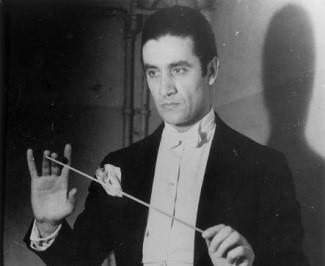
And for the second half of the concert he took the pins out and let his hair loose and wild:
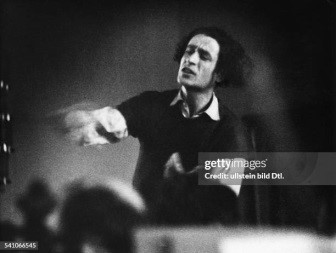
This idea of saving can reflect also on cresc. and dim., or the dynamic range – do it gradually.
2.
Repeat differently, but not a huge difference of the “night and day” type, don’t exaggerate. Vary with shades and subtlety. Learn how the great composers did it.
3.
Think long lines and phrases.
4.
Lead a line right to its end. Don’t stop or hesitate before the end of the phrase. Keep the tension through the last note of the phrase; however, make sure not to accent the last note. Never lose a melody note, not in the beginning, middle, or end of a melody. Don’t sneak into a melody, always show its first note.
5.
Be precise on when to let go of a note, “play the rests” – like you play the notes.
Be precise with rhythm, for example, make sure you don’t play a dotted eighth/quaver followed by a sixteenth/semiquaver as triplets.
6.
Connect things and make them belong so that they are integral. Everything depends on what was before and what comes after. The present is made of the past and the future, as it is conveyed in the article Past and Future by Asher Zvi Hirsch Ginsberg, one of the foremost Hebrew Essayists, primarily known by his pen name, Ahad Ha’am.
7.
Shape your phrases.
8.
Make waves but don’t make the listener seasick.
9.
“Intonation” – acknowledge leaps in melodies, and show the tension the intervals create.
10.
Pay attention to harmonic changes, counterpoint, and inner voices.
11.
Respect the style of a composer, a period, and a piece.
There is a theory and a European tradition that says: a third movement of a Mozart piece should be twice the speed of the first movement.
- There is a theory that says: forks (hairpins) are not marking only dynamics, but also speed. A dim. fork means to also get faster, and a cresc. fork also means to get slower.
- Another theory claims that Andante in Brahms means Slow. Therefore, Più Andante would mean Slower.
- Topics and Styles in the Classical period. This is quite a large topic on its own, however, here are some of the topics and styles to pay attention to:
Sturm und Drang (Storm and Stress), Hunting, Gypsy, Lyrical, Military, Turkish, Machinery, Dance, Opera, Opera Buffa, Funeral March, and French Overture.
12.
Altogether, think of the piano like an orchestra, or even better, like a whole opera – there are different instruments and voices, and they produce different colours of sound.
13.
Anacruses (upbeats), grace notes, and gruppettos (turns) are powerful expression tools. Don’t hide or rush them. Make them a part of the melody – everything must be lyrical.
- An upbeat can also be two or three notes, something that is quite favoured by composers. The most popular example of a three-note upbeat is of course the beginning of Beethoven’s 5th Symphony, though there are so many other examples.
- As a matter of fact, thinking like upbeats, and phrasing scales, arpeggios, and various other passages, from the 2nd note in a group to the 1st note in the next group, e.g. 2-3-4-1 in groups of four sixteenth/semiquavers notes, can be very helpful in producing smoothly-shaped passages.
14.
Respect the hierarchy in a two-note phrase or slur. Play the first note deeper in sound and the second somewhat lighter. But not a black and white difference, rather an elegant approach. The two-note phrases can be slow or fast, they can appear as a part of a lyrical melody or a fast sequential passage, and they can be of any note value. We would often see them as two eighth/quaver notes, or two quarters/crotchets, as well as a quarter/crotchet and an eighth/quaver, but they exist also as halve/minim and whole/semibreve notes. This already brings us to the next subject, which is the relationship between measures.
15.
The same hierarchy among beats in a measure exists also among measures, like micro and macro. We just view the measures as augmented beats or mega beats, for example, in a 4-beat measure, the first beat is the heaviest, the third beat is somewhat lighter, the second beat is even lighter, and the fourth is the lightest. The relationship between the 1st and 2nd beats as well as between the 3rd and 4th beats is like a 2-note phrase. However, the relationship between the two halves of the measure is also like a 2-note phrase. Now apply the same to four measures. This can be multiplied and applied to eight measures, 12, 16, etc.
16.
The classical phrase is divided as follows: short + short + double the length. Of course there can be variations on the idea, but usually it is as simple as that. It can be 2 bars + 2 bars + 4 bars, 1 + 1 + 2, and other such ratios. It is pretty clear in most music, but when it isn’t, it is our job to make it clear. I just love it when it is adopted in popular songs and even in lyrics: “Somewhere over the rainbow, skies are blue, And the dreams that you dare to dream really do come true.” You can’t break the 2nd line with a comma like in the first line; you can’t put a comma after “to” because “to dream” needs to be with no break. So you get 2 bars and 2 bars in the first line, separated with a comma, and the next line is a long one over 4 bars.
When all this information is learned, internalised, and becomes your second nature, it is the right time to let your imagination and inspiration loose. An art without imagination and inspiration is only a skill. However, we do need that skill to be able to express the art.
I learn everything from the great composers. For me, the score is like the Bible, and the composer is like God.
Find out more about Rami here:
Blood, Sweat, and Tour: Notes from the Diary of a Concert Pianist

Thank you Melanie for this info!
And indeed I have also read a lot of interesting info from Rami on how one best interprets a piece.
He describes everything in great detail.
Highly recommended for everyone 😉
Thank you, Martin. That’s great to hear! 🙂