
Earlier this week I had an appointment for my three-yearly mammogram. There’s nothing vaguely interesting about this event, but, for me, it’s a more stressful undertaking than for many because exactly fifteen years ago I was diagnosed with breast cancer. I was fortunate because the cancer was caught early and I’ve been able to make a full recovery. However, one is still wary of any kind of test that may precipitate bad news coupled with possible invasive procedures.
At the mammogram there were two mammographers, something that I’ve never experienced before during the numerous mammograms I’ve attended. One of them was ‘in training’ which made for a more jolly, convivial appointment. It took a while for the newbie to move me into the necessary position; it was surprisingly difficult to rest my arm ‘over’ the back of the x-ray machine in order to ‘relax’ it into position so that both my shoulder and upper torso lined up correctly with the top of the machine. ‘Shoulder down’ I was told, repeatedly. Luckily I realised what was required and was able to ‘release’ my shoulder and arm easily.
Perched next to the unwieldy x-ray machine, I unexpectedly thought of all those students with whom I’ve worked over the years, many who originally displayed all the same ‘tense shoulder’ predicaments at the piano. And, rather like myself at the x-ray machine, they didn’t even notice that their shoulders were not cooperating and were stuck in that uncomfortable ‘raised’ position. Shoulders are, in my opinion, one of the most tricky areas of the body to deal with when learning to play the piano. They surreptitiously ‘hide’ behind the arms, wrists and hands, but if they are stiff or raised in any capacity, it can have a negative impact on piano playing, and very often the ‘raised-shoulder owner’ has no idea what is happening north of their arms.
Why do we do this? Usually it’s a sign of tension, stiffness and a general discomfort caused by worry and anxiety when playing the piano. Why don’t students notice what they are doing? Because it’s far too easy to be totally focused on the music, on what we are learning, and on what the fingers and hands are doing to even think about other parts of our body. Why should we worry if our shoulders are raised when we play the piano? Because the tension and discomfort it can cause will eventually preclude us from playing accurately at speed, and it can also stop us from producing a good sound at the instrument.
How to deal with this problem? For me, the best way is to start talking about it. This draws a student’s attention promptly to what is happening. Some don’t believe they have this issue to begin with, so I ask them to play something and then, with their permission, rest my hand on their shoulder at which point it becomes quite clear that the shoulder/s are raising up as the student is playing.
The next stage is to find a workable solution to alleviate this issue. I use a particular exercise which I call the ‘arm-swing’ followed by the ‘hand rest’, both of which draw a student’s attention to their body, and they also spotlight the tension often residing in the arm, wrist and hand, too. I usually begin every piano technique workshop with the following exercise:
- Sit comfortably on your piano stool in an upright position, with your back straight as opposed to hunched over the keyboard. Allow your arms to swing by your side.
- Focus on the ‘feeling’ in your arms as you do this. They should feel ‘heavy’ as they relax, swinging loosely from your shoulder. It can help to describe how they feel: heavy, lazy, ‘dead’, a feeling of weightlessness, or loose, are a few comments from students after working at this exercise in my lessons and workshops. Now ensure your shoulders are completely relaxed and are not raised at all. Enjoy the released feeling of your swinging arms for a while.
This exercise allows us to ‘feel’ the heavy weight in our arms which can only really be developed if the shoulders are relaxed.
Now let’s look at the ‘hand rest’ exercise:
- Raising your forearms from the elbows, place hands on the keyboard, encouraging them to depress the keys. The hands and fingers should be completely flat, just resting on the keys, but yet taking the whole weight of your arms, like this:
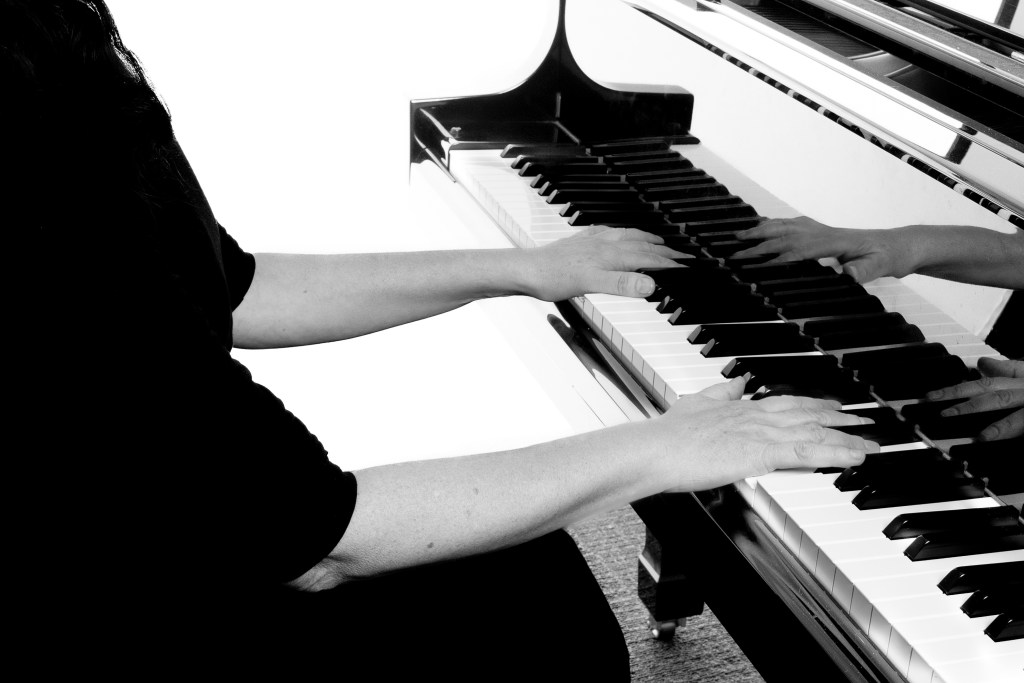
- Now, allow the wrists, hands, arms, and shoulders to relax as they rest. As you experience the necessary ‘release’ effect in both your shoulders and your arms, they should feel ‘heavy’ and relaxed as they did whilst swinging by your side, and if they don’t, try to loosen your upper body in order to recreate that ‘feeling’; it’s all about releasing your muscles and tendons. This will only happen if you use the keyboard as a solid resting place for your hands, whilst paying attention to how your body feels. The last comment is probably the most crucial – you must pay attention to ‘how’ your body feels in order to improve your posture at the piano which can take much concentration.
- That relaxed sensation you’re now creating in your shoulders, arms, wrists and hands, should ideally be the one you hone and develop as you play the piano, eradicating the rigidity that can be encountered the minute our hands touch the keyboard.
A comment that students often make is that their fingers feel loose and floppy once they use this exercise. This can happen, so we then work at building up finger power by using the weight of the arm via a relaxed, loose wrist and hand as opposed to using a fairly rigid upper torso which is what so many students try to do hence the reason tension tends to manifest in the first place.
I appreciate that it’s tricky to implement such an exercise after a lifetime of tensing up, but if you can work at this several times during every practice session, and try to cultivate the comfortable ‘feeling’ of released shoulders as you play, then it will eventually become a good habit.
Photo by Nigel Msipa on Unsplash

Hello Melanie,
I understand that such a control examination always causes you some stress, fortunately you have fully recovered.
It is interesting that through your personal experience at this examination moment you put the position of the shoulders during piano playing in the spotlight again.
And yes, I also think this deserves too little attention.
From now on I will note this exercise in my piano day notes planning book during the warm-up phase.
But it is also important during piano playing itself, not so simple because indeed all attention usually goes to the piece, which is why I take more breaks.
I print the exercise on paper and place it in the field of view until it becomes a habit. 🙂
Thank you again Melanie for the tip!
Hi Martin, I’m so glad that you have found this post useful and of interest. Yes, we have to be aware of the dreaded ‘shoulder raise’ when we play as well as beforehand! There are so many things to think about! Melanie 🙂
This is such an important lesson, Melanie. Thank you so much. I’m going to do these exercises. And I’m glad your mammogram went well. I need to schedule mine!
Thank you, Barbara! I’m so glad that you’re going to implement these exercises – they are really useful! Hope you’re keeping well 🙂
Thank you so much for this advice which is already helping. I’m been working through the first dozen Hamon exercises for a couple of months and my left hand has recently been feeling a bit weak. Just following your advice today has already made a difference and my fingers feel less weak. Thank you! I’ll continue with your approach.
Hi Sandra, I’m delighted to hear that these exercises are helping your LH already – my students find them really beneficial too. Melanie 🙂
For many years I had been unaware that my shoulders were raised and contributing to tension until a new teacher pointed it out by which time I was post grade 8 and busy teaching others!! This is such a good topic and I look forward to trying out the exercises. Thank you.
Hi Julie, many thanks for your comments. I do hope you find the exercises useful. Melanie 🙂