
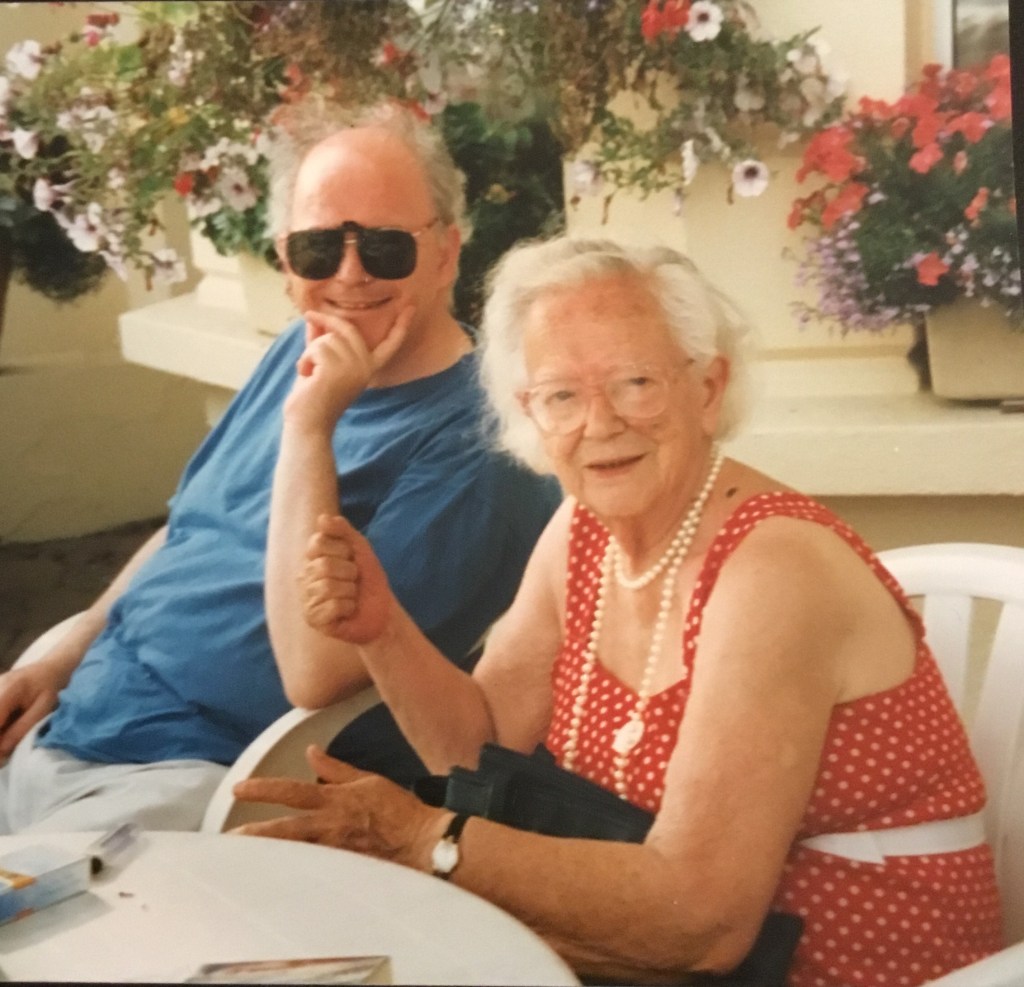
Pianist and teacher Julian Jacobson is my guest writer for this bank holiday post. Julian is no stranger to my blog having written many interesting and informative articles and several guest series. This new series will focus on his mother Margaret Lyell (pictured above), and more specifically, her piano music.
As a musician and writer dedicated to highlighting the music of female composers, I was delighted to discover Margaret’s music and I’m really looking forward to learning more over the coming weeks.
On Friday May 30 at 7.30 in the CBSO Centre Birmingham I shall be the soloist in the first performance in modern times of the piano concerto “Schiehallion”, composed in 1929 by my mother Margaret Lyell (1910-2000) and first performed by her at the Royal Academy of Music, conducted by Sir Henry Wood, in the same year. For some years I have been hoping to find a chance to bring the work to life again, and when I heard that a new orchestra, the Romantic Revival Orchestra, had been founded in Birmingham specifically to perform modern tonal/modal or neglected older Romantic music it seemed like an ideal opportunity for a possible performance. I approached the director, Wiktor Wysocki, and to my great delight he immediately agreed. The conductor will be Tommaso Nista, and as my mother’s piece is a single movement lasting around ten minutes I’ll also be playing the (Robert) Schumann Concerto.
The title of her concerto, Schiehallion, refers to a beautiful mountain in Perthshire with folkloristic and mythical associations – its name derives from the Gaelic “Sìth Chailleann” meaning ‘fairy hill of the Caledonians’ – and I’m sure her childhood included many family visits to the mountain.
Margaret Sutherland Dorothy Lyell was born on July 17 1910 in Perth, Scotland, the youngest of three girls. Her father, Dr John Lyell, died when she was four. She showed early talent both as a pianist and a composer, writing music for a play mounted by her older sisters at the age of five. After winning many prizes in local competitions she won a scholarship in 1928 to the Royal Academy of Music in London to study piano and composition, the latter under Julius Harrison, the founder and first Vice-President of the Elgar Society. She composed her concerto as a nineteen-year old student at the Academy and first performed it there with Sir Henry Wood conducting.
Following the Academy she was awarded the St James Caird Travelling Scholarship for further piano study in Berlin under Ilse Krause, daughter of Liszt’s last German student Martin Krause who taught Claudio Arrau and Edwin Fischer among others. So you could say that I’m a grand-pupil or great-grand-pupil of Liszt, though many pianists claim such a lineage and I don’t set much store by it!

In any case, when I was a small child she could still give fine performances (or so they seemed to me at the time, but I’m sure they were) of such things as the first two Chopin Ballades and many of the Preludes, to which she added those of Scriabin later in life. She could also play by ear all the popular tunes of the day in high style. Although never a professional pianist, she continued to play as well as as compose until near the end, leaving a substantial body of choral music and instrumental pieces, many intended for children and some of which have featured in ABRSM and festival syllabuses. Her music is ripe for rediscovery and I hope my performance of the concerto will help to kickstart a revival!
In future posts I shall discuss her adult musical life and compositions as well as talking in more detail about her Concerto.
Find out more about Margaret Lyell by clicking here and you can purchase tickets to hear the concert by clicking here.


Hey Melanie,
Julian can be very proud of his mother.
Curious about the next posting…..
Best wishes,
Martin Bekaert
Thanks, Martin. Yes, I agree, he can and should be proud. Melanie 🙂