
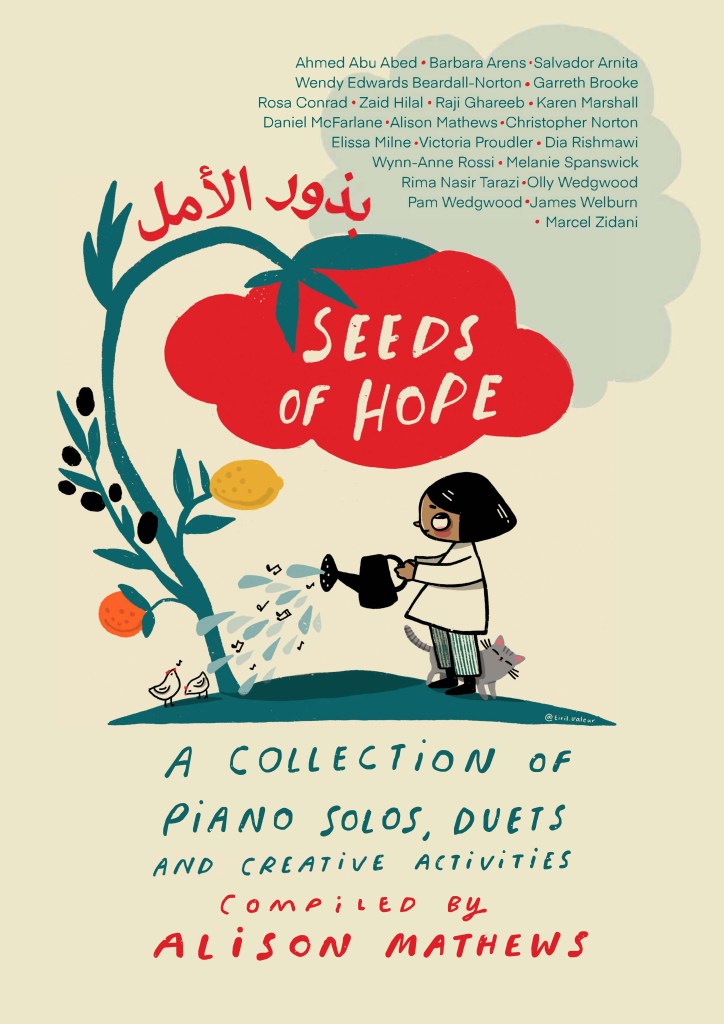
Today’s guest writer is pianist, teacher and composer Alison Mathews. Over the past year, Alison has compiled and edited a very special publication called ‘Seeds of Hope’: a collection of elementary level piano pieces featuring Middle Eastern themes with a focus on nature, growth and hope. Each work in this volume has been written by a renowned educational composer and all proceeds go to two music charities helping children in Palestine. I was delighted to be invited to contribute a composition and have enjoyed watching the book’s development over the past year.
In this article, Alison writes about how this project came to fruition, and the work required to provide the necessary ‘legs’ needed to ensure its success.
At the start of 2025, I attended a fundraising concert in central London for a children’s charity, organised by a classical musician’s collective. I came away inspired and challenged myself to do something. By that point, the true horror of more than a year’s conflict in Gaza, involving the extreme hardship experienced by families and tens of thousands of children, had become a regular feature on my news and social media feed.
To counter my feelings of helplessness and to effect change I had already become involved with peace rallies and raising funds for refugees, but I still felt strongly that I could do more. But what exactly and how?
As an established educational composer with a portfolio of published books and commissions, the most natural thing was to write music. As a teacher who has long believed that all children should have access to music education, regardless of their circumstances, I decided that my personal challenge and goal should be raising funds for two charities who are making a tangible difference to children’s lives: PalMusicUK and Musicians Without Borders.
PalMusicUK are the UK ambassadors for the Edward Said National Conservatory of Music (ESNCM), funding scholarships for young musicians in Palestine to study at the conservatory as well as providing instruments to the school. They also award scholarships for talented Palestinian musicians to study at UK conservatoires, such as pianist Marc Kawwas who is currently at the Royal Academy of Music. In addition, they provide support for international tours of the Palestine Youth Orchestra and the choir Daughters of Jerusalem, who visited the UK in November 2025.

Musicians Without Borders is an award-winning charity supporting local musicians and organisations that provide community music programmes in places across the world affected by war, armed conflict and displacement, including Rwanda, Jordan, DR Congo, North Macedonia and Palestine. Their message is one of hope, using music to create a positive change in local communities. In their words: “even in the hardest moments, music can offer a space for expression, connection and strength.”
In spring 2025, I began mulling over ideas for an educational fundraising book. I was aiming to weave together folk and original music with a theme that would have wide appeal and provide a connection across cultures. The theme of nature and the strength we draw from it, as well as the theme of growth and hope, felt right for the circumstances.
To be successful, I was very conscious that the book needed to be of high quality and of pedagogical value. I knew that a collaboration of highly regarded international composers would have strength, impact and reach, as well as the potential to bring both Western and Arabic music traditions together. A challenging task, but one that I wanted to achieve within that year.
Initially I tentatively approached colleagues and friends and then gradually reached out to other composers. The response was enthusiastic overall, with so many seeing the project as a meaningful way to contribute in a situation where it is easy to feel powerless.
I am so very thankful to those composers who joined me in the endeavour and to the artist Tiril Valuer who created all the artwork for the book – everyone involved gave their time freely.

I began with a little knowledge about Arabic music but far less of Palestinian music specifically, so I spent some time researching. Alongside that, acquaintances met at peace rallies led to new Palestinian friends who offered advice and shared music. This was followed by a stroke of good fortune!
A parent of a former student of mine, learnt about my plans and passed on the contact details of a musician in Bethlehem – Viktor. This proved to be a real turning point. Viktor introduced me to a musician friend of his – Raji Ghareeb – an Academic Supervisor at the Bethlehem branch of the Edward Said National Conservatory of Music (ESNCM) and I sent an email explaining my project. This arrived during their most busy time, full of end of year assessments and organising summer workshops, but in time I received a wonderfully encouraging reply from Tamer Al-Sahouri, the Academic Director.
In my search for source material for the book, I had seen that the conservatory had their own publication ‘Let’s Play: Arabic Melodies for Beginning Pianists’. I asked if I could purchase a digital copy, in order to make sure that the folk melodies I wanted to use were as accurate as possible, especially as arranging music for piano that makes use of quarter-tones needed some sensitivity. I didn’t expect the reply I received – an offer for me to reproduce any of the pieces from the book, as well as advice on arrangements and further music I could include. This was a god-send as I had tried various avenues to find Palestinian composers. To have well arranged traditional folk music included, as well as music from highly regarded Palestinian composers and musicians, was vital to the project.
The next turning point happened in July 2025, when Raji visited the UK for a tour with the Palestinian singer-songwriter Zaid Hilal, who is an alumni of ESNCM. I met both Raji and Zaid at one of the concerts at Palestine House in London. They were so generous with their time, supportive of the project and I was offered more music! This time a powerful song written by Zaid, dedicated to the children of Palestine – ‘Libre Palestina‘. This struck me as the perfect closing piece for the book, with Raji offering to arrange it as a piano solo. The concert itself was inspiring, bringing to life so much of the folk music I had been listening to whilst researching and composing.
The project moved forward quickly and although developing an educational music book usually takes a very long time, I was able to publish ‘Seeds of Hope’ as both a digital and physical book just a few months later in September 2025.
Then it was time to promote the book and fundraise. I approached two well-known pianists with excellent Youtube channels to record the music – Julian Lambert and Jill Morton – and a playlist was created (click on the link below to hear all the pieces in the book).
As well as relying on my own network to help, I’ve had to quickly learn how to engage with Instagram (thanks to my younger son!); approached reviewers; emailed shops to negotiate sales, with several independent retailers now stocking ‘Seeds’; sold copies at concerts and events, including the National Education Union’s annual conference on Palestine. I was delighted to make the first donation of £1000 in December 2025. We are now close to the second goal of another £1000, with the money still desperately needed.
It continues to be challenging, rewarding and at times exhausting, with success reliant upon a steep learning curve and a multi-pronged attack!
Now to tell you a little about where the money is going and why it is so important to support these causes. ENSCM was the first music conservatory established in Palestine in 1993, with just 40 students in Ramallah. From these humble beginnings it now provides music education to approximately 2,000 students across several branches as well as community programs in refugee camps. It has an international reputation for academic excellence and their achievements in community music.
Currently, the ongoing conflict has seen the Nablus and Hebron branches temporarily closed whilst in Gaza the conservatory’s building was reduced to rubble by widespread bombing in the neighbourhood. Students and teachers were displaced to various refugee camps and valuable music instruments were lost. Despite the truly terrible conditions the conservatory adopted an emergency plan focussing on supporting teachers and students, with workshops and classes held in tents and shelters for children surviving devastating hardship.
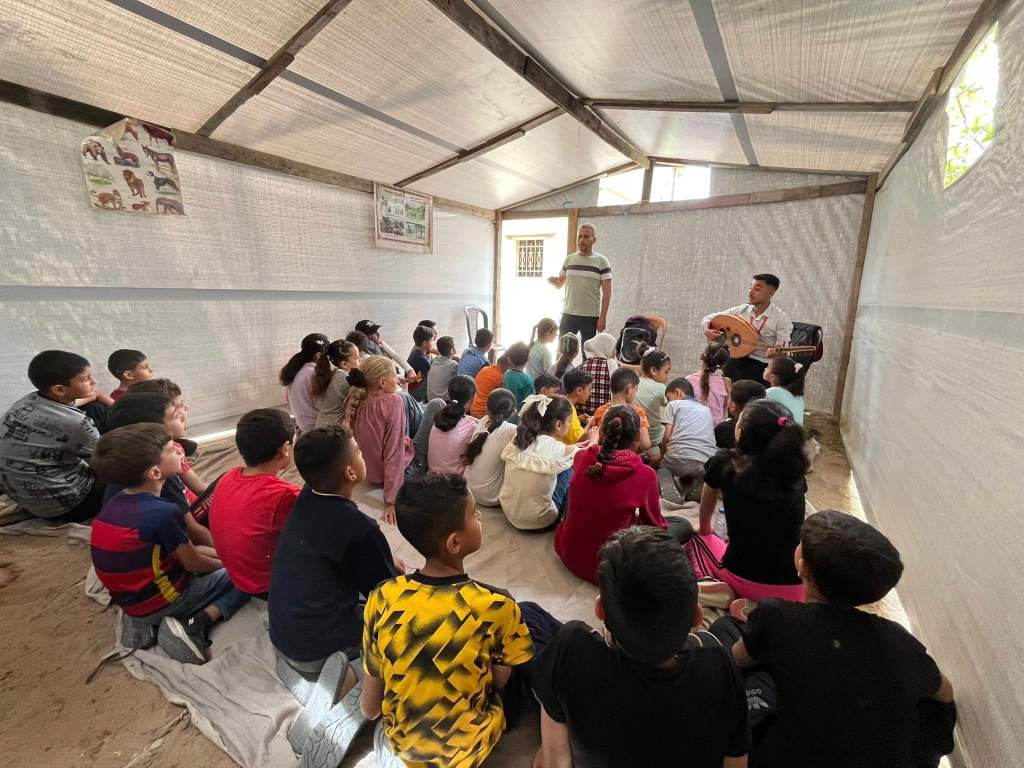

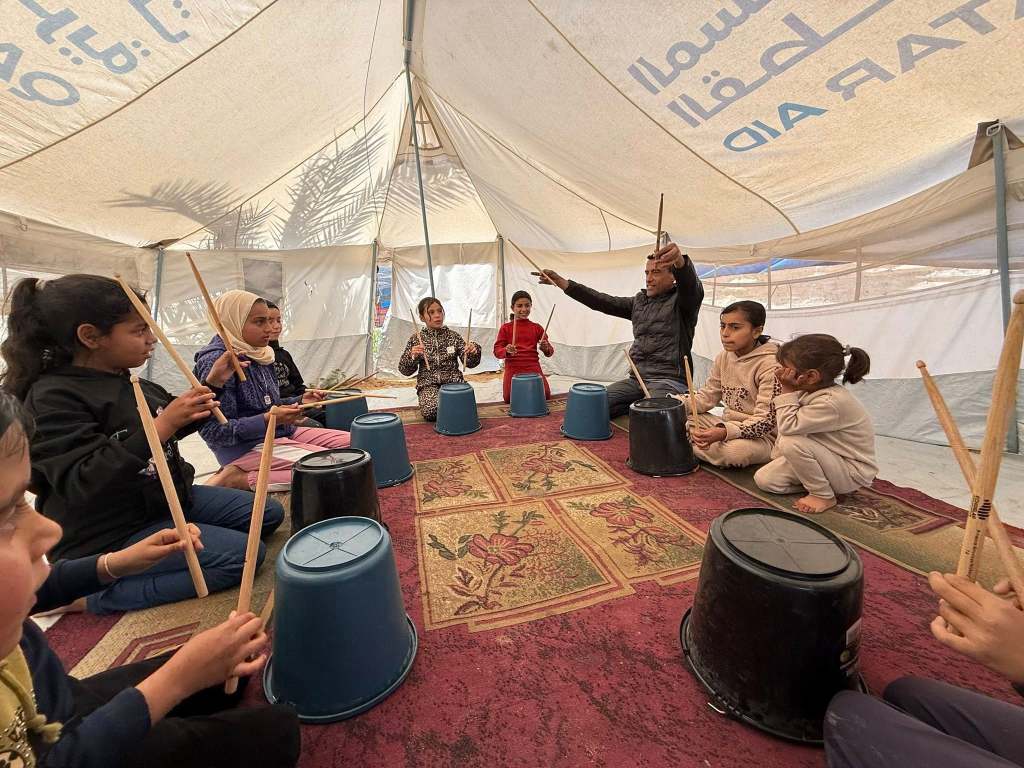
Teachers and students have had to adapt to extremely difficult circumstances. Mohammed Abu Aid, a 14 year old student at the conservatory, was badly injured in 2024 when Israeli forces bombed the school where he was sheltering, leading to the amputation of his right arm. Just two weeks after this and unable to continue playing the oud, he began violin lessons with Sama Najm, using a scarf tied to his arm to support the bow. At the Nuseirat refugee camp, where oud lessons and choral singing continues, music teacher Mohammed Al-Habbash described their first gathering – “Even with all the horror, I couldn’t describe the scene. I saw joy in the children’s eyes. I forgot about the war. I felt like I had come home.”
As a visiting music teacher myself, I can only imagine the tenacity, commitment and strength needed by the teachers in Gaza who have taken great personal risks to continue providing music education for young children and students in their communities.
In March this year, there was good news. The conservatory found a new building in Gaza City to operate from, which is now the centre for all of its activities in the area. New students, alongside those whose studies had been interrupted, are now able to enrol again in a variety of instrumental and singing lessons. The difference music can make in children’s lives is expressed beautifully by Rifan al-Qassas, a 15 year old lute student “When I play I feel like I’m flying away. Music gives me hope and eases my fear.”
Despite experiencing such hardship and devastation, the fact that music provides a beacon of hope and relief from fear, reinforces my strong belief that ‘Seeds of Hope’ has an important role to play in promoting cultural awareness and raising funds to support the lives of children caught up, without their choice, in areas of conflict across the world.
I’d like to end the article with a performance of one of the pieces in ‘Seeds of Hope’, by ESNCM student Marianne Matta. ‘I am a Palestinian Child’ is written by the renowned Palestinian composer and one of the founders of ENSCM, Rima Nasir Tarizi.
I’d also like to say thank you to everyone who has supported the publication of ‘Seeds of Hope’ and most importantly, bought a copy of the book. If you would like to help continue spreading musical hope, you can buy a copy of the book by clicking on the link below or make a donation directly to PalMusicUK or Musicians Without Borders.
Quotes are taken from an article in The Institute of Palestine Studies by Thaer Abu Ayyash and Reuters.
Images are my own and from ESNCM and the above articles.

Photo by Nazar Hrabovyi on Unsplash
