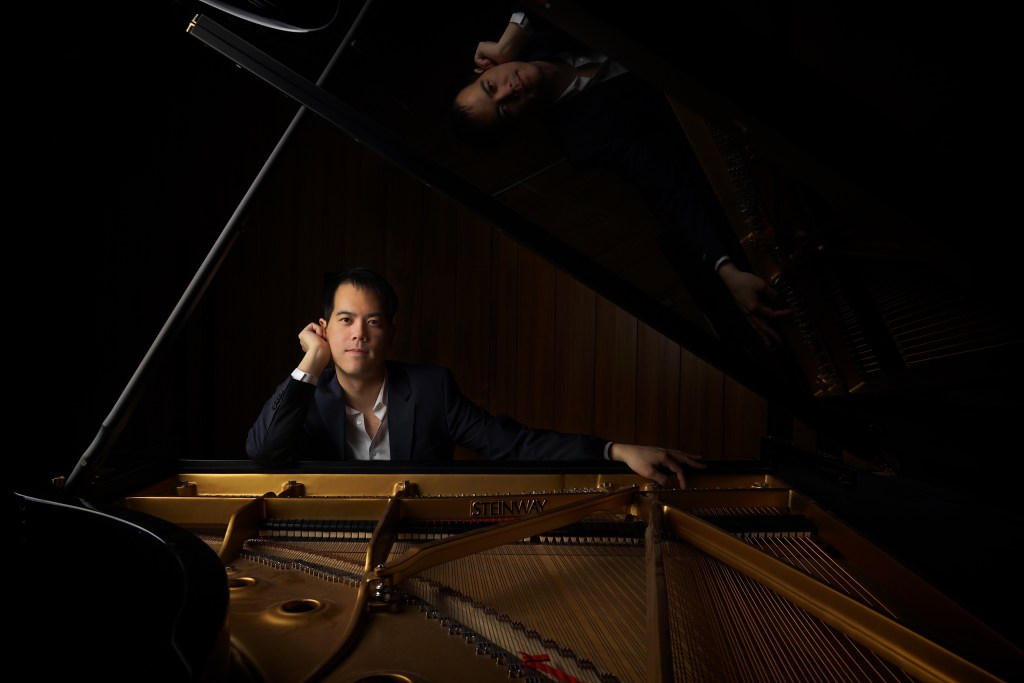
My Piano Pedagogy Spotlight guest is currently American pianist and piano professor Frank Huang. In this interview, Frank discusses his performing career.
How did your extraordinary nine-disc project, recording the works of Russian composer Nikolai Medtner, come about? What attracts you to this music?
I first encountered Nikolai Medtner’s music as a student at Juilliard in 2005. I was attending Piano Forum, recitals organised by the school where interested students would play, and I heard Konstantin Soukhovetski perform Medtner’s Canzona matinata (Morning Song) and Sonata tragica (Tragic Sonata) from Forgotten Melodies, Op. 39. Konstantin’s performance made a strong first impression of the composer with his electrifying and passionate playing while never losing sight of the work’s beauty. But I remember that the music also had some sort of visceral effect on me. I found the tuneful melodies and spellbinding harmonies to be particularly entrancing.
Ten years later when I was thinking about a creative endeavour that I wanted to pursue, my mind circled back to Medtner. I searched YouTube to see what performances could be found and there weren’t many. Some notable recordings included the composer’s performances of his own music, Emil Gilels’ legendary playing of Sonata in G Minor, Op. 22, and Horowitz’s performance of Fairy Tale, Op. 51, No. 3, which was the only Medtner work that he ever recorded.
But the two pianists that populated YouTube were the late Geoffrey Tozer and Hamish Milne. While technically impressive, I found Tozer’s recordings to be overly brilliant at times, but Milne’s playing really spoke to me. My former teacher at Juilliard, Julian Martin, said the following about him: “he’s THE one foreigner acknowledged by the Russians as being authentic. He’s a gorgeous pianist.” When I was invited to perform on Alexander Karpayev’s Medtner Festival in London in 2017, I reached out to Milne to see if I could meet and play for him while I was in town. Unfortunately, his health was in decline at the time, and he was unable to meet with me.

Performing at the Medtner Festival was a wonderful experience. I had never met so many Medtner-enthusiasts in a single gathering! A highlight of the festival was Alexey Volodin’s performance of Medtner’s Piano Quintet with members of the London Chamber Orchestra. During my downtime, I was able to visit the composer’s grave and home which are located outside the city.


As I have become more familiar with Medtner’s music over the years, I often ask myself: how can we not know of this great music? The way in which he wrote for the piano clearly showed his affinity towards the instrument, similarly to Chopin. He admired the Germanic tradition in the contrapuntal writing and the thematic art of J.S. Bach and Beethoven respectively. To me, his strongest compositional attribute was his exotic harmonic language which Rachmaninov greatly respected. In fact, Rachmaninov stated that Medtner “was the greatest composer of his time.”
My hope with this recording project is to bring long overdue attention to this composer. I released the first volume under Centaur Records in 2021 which consists of Eight Mood Pictures, Op. 1, Fairy Tales, Op. 51, and Forgotten Melodies, Op. 39. I am excited to announce that Volume 2 will be released on February 14, 2025, and it will be available on the usual streaming platforms (click here to purchase this volume). That album contains Sonata Triad, Op. 11, Fairy Tales, Op. 26, 20, 34, and Sonata in G minor, Op. 22. I will say that the Op. 34 set has easily become my favourite Medtner work that I have recorded so far—highly evocative and imaginative writing!

Tell us about your current performing activities. Do you play mostly solo recitals or concerti? Do you have a preference?
Solo recitals constitute most of my performance calendar. Unsurprisingly, I usually include a Medtner work in my programmes, but I also balance my recitals with more familiar works and composers. Recently, I played a solo programme at Cincinnati’s Conservatory of Music, where I presented some rarely heard Medtner works that were balanced with a Debussy Prelude and Beethoven’s Eroica Variations.


As a side note, I spend a bit of time constructing programmes. I really enjoy this creative process. To me, I see this similarly to a chef’s responsibility in curating a menu—lots of thought and planning go into designing dishes, selecting ingredients, creativity and innovation, presentation, etc. As a performing musician, I am constantly thinking of additional ways to reach a broader audience through creative programming. Several years ago, I started an online music series, Rallentando, which was live streamed mini recitals that were more relaxed in nature than a traditional concert. Occasionally, I incorporated photo and video stock art to accompany the playing. Learning the technology involved with these performances, specifically the live-streaming software, was challenging, but rewarding.
I have also been interested in programming more thematic recitals. I believe that such programmes have the opportunity for audiences to relate to the music in a more meaningful way. In February 2025, I’ll present a solo recital in North Carolina entitled “Nostalgia,” which explores compositions that evoke this raw emotion. Featured on the programme are a few late Schubert pieces, written around the time when the composer was coming to terms with his deteriorating health, Medtner’s Fairy Tales, Op. 34, a vivid musical depiction of Russian folklore, and concluding with Mussorgsky’s Pictures at an Exhibition, a musical tribute to the composer’s architect and painter friend, Viktor Hartmann who had passed away suddenly.
Outside of solo work, I enjoy performing as a soloist with an orchestra because of the collaborative nature with a larger ensemble. Last year, I performed Liszt Second Piano Concerto with my school orchestra at Miami University (Ohio) and it was a fun experience to work with the students. This concerto has been on my list of works that I wanted to learn. I just love how Liszt integrates the solo piano parts with the orchestra. I have also performed Gershwin’s Rhapsody in Blue, Rachmaninov Second Piano Concerto, and Grieg Piano Concerto in A Minor recently.
Do you play chamber music? Which repertoire have you explored so far?
Yes, I love chamber music! During my CIM days, I started a piano trio with friends, and we explored a considerable amount of standard repertoire from Beethoven, Brahms, Mendelssohn, Tchaikovsky, and others to lesser-known works such as the Tailleferre Piano Trio. At Miami University, I have collaborated extensively with colleagues. One of my favourite pieces that we performed was Bartók, Sonata for Two Piano and Percussion.
Recently, I have been fortunate to perform with many outstanding musicians in recitals. Last year, I played a recital with Brian Thorton, a cellist with The Cleveland Orchestra. The highlight of the programme was Chopin’s Sonata for Cello and Piano, which I believe is one of the hardest pieces that Chopin wrote for the piano. I have also performed with Ben Hong, Associate Principal cellist of the Los Angeles Philharmonic. He is an incredible musician. We performed Beethoven’s Seven Variations from Mozart’s Magic Flute, Debussy Cello Sonata, and Prokofiev Cello Sonata. I have performed Debussy Cello Sonata a handful of times, and I have never heard it played with such imagination and sensitivity as him. Another chamber music highlight was performing with violinist Cho-Liang Lin in a recital at a summer festival here in Cincinnati. Upcoming chamber concerts include playing Faure’s Piano Quintet in C minor with members of the Cincinnati Symphony Orchestra on their chamber music recital subscription series.

Tell us about your various past recording projects.
I released my solo debut album in 2017 under Centaur Records: Johannes Brahms: Selected Piano Music. This disc featured music written at various stages of Brahms’ life—Sonata in C Major, Op. 1, Scherzo in E flat minor, Op. 4, Waltzes, Op. 39, and Klavierstücke, Op. 119. Find out more by clicking here.
Later in 2017, my composer friend, Jack Gallagher, and I released Jack Gallagher: Piano Music. Jack is Professor Emeritus of Composition at College of Wooster. Jack and I crossed paths when I served as an adjunct professor at the college. I had just graduated from CIM and was juggling an active schedule of teaching at Cuyahoga Community College, my own private students, and performances. At the end of our teaching days at Wooster, Jack and I would talk for hours about music and life which led to this project. Find out more by clicking here.
And then in 2018, I released a chamber music album with violinist, Shannon Thomas: Celebrating Women Composers. This was a fun project—I particularly enjoyed recording Jennifer Higdon’s String Poetic because of the composer’s innovative tonal palette. Find out more by clicking here.
What are your favourite performance venues?
Zelazowa Wola Park, Chopin’s home in Warsaw, Poland, is one of my favourite performance venues. I love its intimate quality and how one can connect with the audience. Carnegie Hall, Weill Recital Hall is another favourite because of its historical, architectural, and cultural significance.
Which performances do you consider your most important? And those which have been most exciting?
In 2020, I developed and presented a thematic recital programme, Odyssey of Dissent, which explored the relationship between protest and classical music. There were several impetuses that inspired this project: my previous experiences of protest music and Rzewski’s People United (find out more about “Rzewski’s People United” by clicking here), the outrage of George Floyd’s murder, and the uncertainties of navigating through a pandemic. While the world was on lockdown, I streamed the concerts at school. Later in 2021, when the restrictions became more relaxed, I was finally able to share this programme with a live audience. Although I have performed in greater marquee events in the past, this programme gave me such musical fulfilment and nourishment. I was able to reach a broader audience and connect with them in a way that made the music relevant to the current tumultuous times.
In terms of most exciting performances, my Carnegie Hall debut and chamber music performances with Cho Liang Lin, Brian Thorton, and Ben Hong rank high on my list. Also, in 2021, I achieved a major milestone in my career: I was named a Steinway Artist. This was truly a humbling experience as I joined a roster that consisted of my childhood heroes. At Miami University, the music department hosted a celebration and ceremony, and I presented a recital. It was heartwarming to see friends, colleagues, current and former students, and university administrators to celebrate this achievement with me.