
This is the fourth and final interview with American pianist and professor Frank Huang. In Part 4 he discusses his love for and approach to teaching.
Why do you love teaching? What is your teaching philosophy?
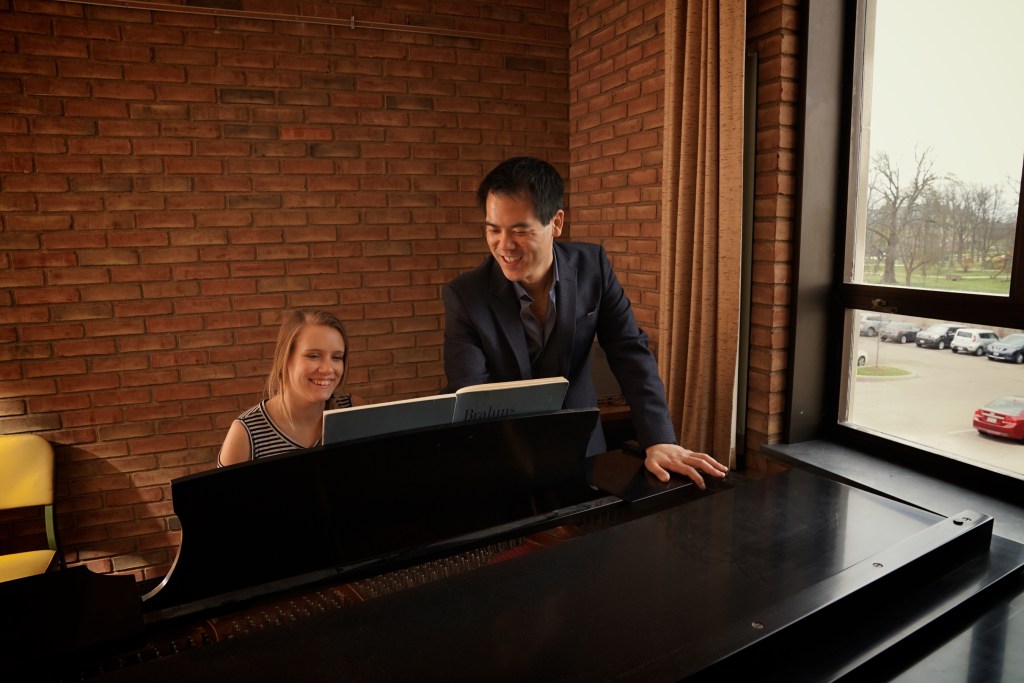
As a piano professor, it gives me great satisfaction and fulfilment to motivate, encourage, and empower students towards developing and articulating their own artistic “voice.” This can only happen if they feel genuinely inspired by the progress they have made and their desire to constantly learn more. I continually practice and refine pedagogical strategies that reveal how curiosity, discipline, and knowledge are all important characteristics of the successful study of music and the arts. In that respect, my teaching method revolves around engaged and active learning, outlined below in three interrelated principles. Reflecting upon my own personal experiences and observations, I constantly remind myself that the most effective teacher is one that fosters an environment of perpetual learning.
Inquiry-Based Instruction
Like the development of any other skill, critical listening and thinking require practice—with constant repetition and recognition of patterns, the more natural and instinctually they will become. To cultivate these habits, I employ a strategy of inquiry-based instruction where the student and I engage in discussion, analysis, and exploration in addressing performance and musical interpretation. For example, I ask students questions that incorporate their knowledge of music theory, history/literature, and pedagogy into performance. In some cases, I ask students to sing and conduct a passage to help them gain a deeper understanding of phrasing and pacing. I ask students to self-reflect their own performances—citing areas of strength and aspects that need to be improved. If appropriate, I involve students by asking them to explain the narrative, especially if it is a particularly evocative work, or the “story” behind a piece that they are playing. Furthermore, how can one communicate these ideas in performance? What are some specific musical details in the score that lead to such a narrative? These efforts not only teach students to think and listen critically to what they are playing but also help in forming their own artistic decisions with my guidance. I generally notice the positive effects of this strategy with my returning students when they apply these concepts to a new piece and have a better idea on how to work before their first lesson with me. I love getting students to think independently and tapping into their huge pool of creative potential that exists within them.
Learning from Each Other
To create an engaging environment where students and I share healthy discourse, I find that it is important that I must lead by example in listening carefully and welcoming all thoughts, insights, and experiences. This type of inclusion is important in creating positive and nurturing feelings for students to share their ideas openly, delve deeper into discussion, and learn about other’s viewpoints. My strategies for creating an environment where we can learn from each other have taken a considerable amount of time to develop (and they are still evolving!) because of the inclusive nature that I am trying to create: each student has their own learning style and personality—some students might need more time to open up; whereas, some might seem more receptive to the idea of being challenged. This is especially the case in our weekly studio class, a forum where the piano students perform for each other and offer critiques for improvement. Performing for people can be nerve-racking, and commenting on someone else’s performance in a respectful way can be even more stressful. How do I encourage everyone to speak out and balance the time so that everyone’s voices get heard? I attempt to address these issues by viewing my studio as a community—a place where students are engaged and challenged in a respectful and supportive atmosphere. This also means that students should adopt a more active role and that they “buy in” to the notion that learning is a shared responsibility. In this setting, I see my role as a facilitator of learning, rather than a provider of information. Employing this principle is more challenging than retaining the traditional roles of student and teacher, but I have found that the work has been completely worth it.
Application to Our Daily Lives
In my lessons, I often relate my teaching with examples to daily life and other student interests. I’ve always done this, and I think this stems from my teaching days in Cleveland where I had a lot of adult students who had no prior musical background. At Miami University, where I currently teach, I have students with wide-ranging backgrounds. For example, one of my students was a competitive athlete in high school. He participated in matches every week. After each event, regardless of the outcome, his coach would go over the film and discuss areas of strength and things that needed to be improved. I used this exact example in explaining to him that the preparation for public performances was no different. One must constantly perform for others to improve. Self-reflection is accomplished by recording one’s own performance and reviewing it while following the musical score intently. It was rewarding to see how he immediately understood and recognised the connection.
Lastly, there has been much research about this, but I will echo that music, regardless of whether one chooses to pursue it as a profession (that’s another interview topic for another day!) is an ongoing process of refining skills that are transferrable to other disciplines such as critical thinking/listening and growth of proficiencies in problem-solving, time management, and emergent, hard-earned intellectual autonomy.
How do you build a student’s technique? What teaching repertoire do you enjoy using?
“Fundamentals, fundamentals, fundamentals. You’ve got to get the fundamentals down because otherwise the fancy stuff isn’t going to work.” – The Last Lecture, Randy Pausch
I love this quote because it applies to everything that we do. Fundamentals are the core tenet of my teaching. I require all my students, both undergraduate and graduate levels, to prepare technical exercises each week that consist of scales in variety of formats (parallel and contrary motion, intervals apart such as 3rds and 6ths, etc.), blocked and broken chords, and arpeggios. Without having to worry about notes and fingerings (hopefully!), I can focus solely on technique-related issues as these exercises are the building blocks that enable students to study more difficult repertoire.
I have a set of teaching pieces that I regularly assign to students. I learned this idea from Julian Martin. Before my first year at Juilliard, Julian discussed repertoire that he wanted me to prepare for our first lesson, and among the list of pieces was Chopin’s Etude Op. 25, No. 3 because it addressed finger dexterity and wrist rotation. I found out later that he routinely assigned this piece to his undergraduate students. He always believed in building technique through repertoire. Even though he had a repertoire “template” of assigning certain pieces to multiple students, he would always adjust based on student needs.
This philosophy has always stuck with me when assigning repertoire. Here are some pieces that I have used for various student levels throughout the years:
Bach Prelude and Fugue in E minor, from the Well-Tempered Clavier I: a great introduction to fugal playing as it is the only two-voice fugue from the Well-Tempered Clavier.
MacDowell Etudes: I used these pieces a bit for my pre-college students. I think they are a great bridge to the harder pre-Chopin etudes like Moszkowski.
Debussy, Pour le piano: this was also another Julian Martin favourite.
Mozart Sonatas, K. 309 and K. 283
Beethoven Sonata, Op. 10, No. 2
Brahms Rhapsody Op. 79, No. 2
Ravel Sonatine and Jeux d’eau
You are an Associate Professor of Piano at Miami University in Oxford, Ohio. What does this role entail?
I was appointed to the music faculty at Miami University in Fall 2013. My position has three components: teaching, creative work, and service.
Most of my teaching is one-to-one lessons. My studio consists primarily of undergraduates and a few graduates, totalling 10-12 students each semester. With Miami University being a liberal arts institution, I work with several music minors and double majors. I enjoy working with this cohort because they bring a different perspective that is welcomed to the piano area. I also coach one to two chamber groups. Every other year, I am responsible for teaching Piano Literature. I really enjoy this course as we get to explore various topics: historical performances, performance practice, social function of music, key characteristics of composers, and more. It is always a challenge because I need to cover over four centuries of piano music in an academic year! Outside of Miami University, I give guest masterclasses, presentations, and lectures as part of my position.
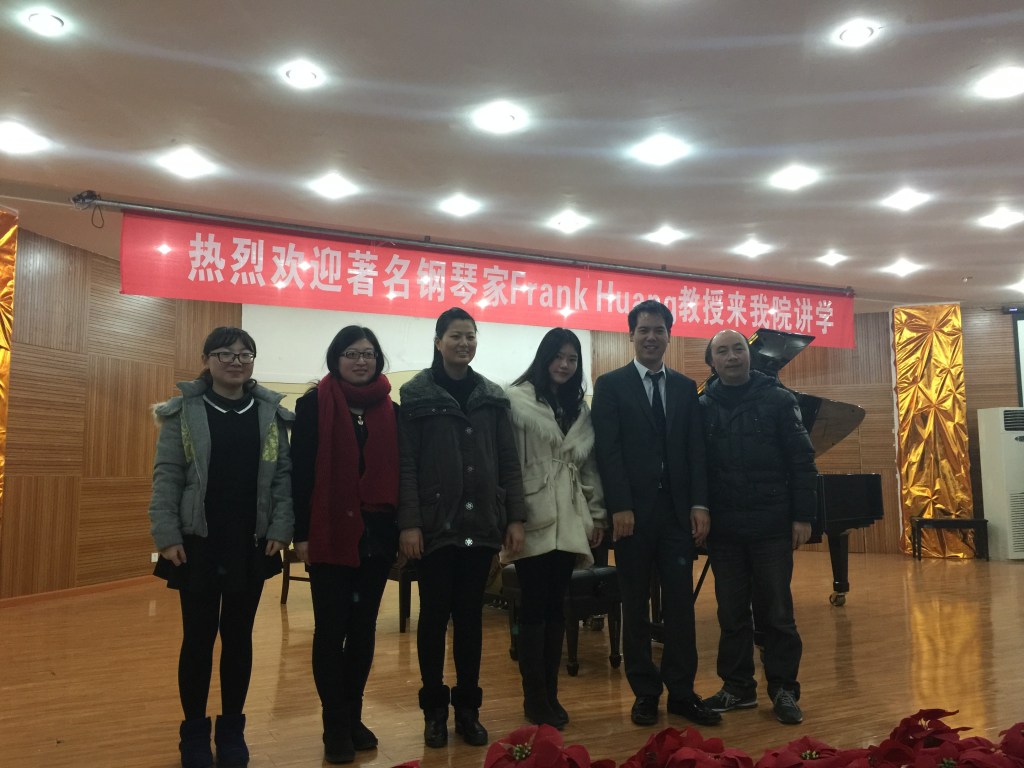
I am also expected to be productive in creative work and research which are centered around piano performance. As I shared previously, this involves my performances and recording projects.
And lastly, service is a major component of my position. This involves various committee assignments for the department of music, university, and the profession.
What is the relationship between your teaching and performing activities and how does teaching improve performance?
I believe that teaching and performing are inextricably linked because both activities relate to experiential learning. That is, one learns from doing and experiencing. As a teacher, I will be more effective if I can draw upon my previous performing and teaching experiences when advising students. For example, I have found this to be especially the case when it comes to helping students cope with performance anxiety, preparing for recitals, and fostering good practice habits. Indeed, Malcolm Gladwell famously theorised the idea that it takes 10,000 hours of deliberate practice to successfully gain command of a skill. While it is a bit generalised and doesn’t always account for variables, I believe there is some truth to it.
I’ll share a brief story that best illustrates how there is no substitute for experience. I once met a cardiac surgeon who was also an amateur pianist. She had just recently performed the Grieg Concerto with a local community orchestra. I asked her, “what makes you more nervous: performing piano in public or surgery?” She said without hesitation, “of course, performing piano! With surgery, I have done so much training and have banked so many hours and experience, it has become natural to me.” I was quite surprised by the answer, given the high stakes and litigious nature of her profession, but the more I thought about it, the more it made perfect sense.
On the other hand, I have learned so much from my students. As performers and teachers, I think we all have been in a situation where we realise that we should “practice what we preach.” But I believe that the connection between teaching and performance runs even deeper. All our students come from diverse backgrounds. They learn and respond differently which requires teachers to tailor instruction to the individual, causing us to constantly adjust how we deliver our pedagogy and methodology even when we are teaching the same concepts or material. I believe that this process inherently develops an even greater mastery of our craft which certainly transfers to the performance stage. I believe that teaching and performance have a symbiotic relationship, and I have become a better musician through my students.
Can you share your most important practice habits?
Slow practice doesn’t only happen when learning notes
This is something that I constantly emphasise to my students. The misconception is that once we have learned and memorised the notes, slow practice (and hands separate practice) doesn’t need to happen anymore. Or even worse, we don’t need to actively read our music anymore. This is furthest from the truth! At this stage, we are analysing the piece further: breaking it down to its fundamental parts and examining each component carefully to understand their meaning and significance. This can only happen with slow practice! And on to my next point…
Ultra-slow practice
There is a legendary story of Irish pianist, Charles Lynch, who overheard Rachmaninov practising Chopin’s Etude, Op. 25, No. 6. According to Lynch, he reported that Rachmaninov played at “twenty seconds per bar for almost an hour” and because the tempo was at such a “snail’s pace” it took him a while to recognise the piece.
Now, I don’t believe at all that Rachmaninov was practising slowly for note reading and physical comfort. Or even for extended time to think in between the notes. It was for his ears—to listen to the legato quality in the RH thirds, the shaping of the LH arpeggiated figures, the counterpoint within the LH part, how the LH interacts with the RH, pedalling, and more.
I take ultra-slow practice one step further. I strip tempo and rhythm out of the equation temporarily so that I can get down to the bare bones of what I am trying to accomplish at the moment: listening. I usually use this method when practising Bach or other polyphonic, contrapuntal music.
Slow practice is not always helpful
It is not a coincidence that the first two important practice habits that I shared revolve around slow practice! It is generally the go-to answer when diagnosing and troubleshooting potential problems in the music… however, there are certain situations when I think a better solution exists:
- Working on phrasing, rubato, and pacing. Additionally, I generally tend to practice slow pieces quickly and fast pieces slowly.
- Acquiring greater comfort in a technical passage: frequently, I hear my students break a passage down beat by beat with metronome and gradually work up the tempo. While this can be helpful initially, I believe it is not the most efficient method to gain technical command of the passage. I’ve actually blogged about this topic on my website, but I would practice first how the passage feels (dividing the passage into hand position groupings, leaps and wide stretches, etc.), vs. how it looks on the page (rhythmic groupings). Once I’ve determined hand groupings, I typically practice these with a singular semi-rapid impulse.
You’ve written many practice articles for various piano magazines and websites, and you’ve also made tutorials for publisher Henle Verlag. Do you find this a beneficial way to share your teaching with a much wider audience?
Yes, I do. I enjoy writing such articles because I can reach a broader audience than the traditional student. This interest stemmed when I was a graduate student at Juilliard. For a semester, I volunteered my Friday afternoons to teach group piano at an underserved elementary school in Harlem. The classroom did not have enough keyboards for the students and parents could not afford to provide keyboards at home for the kids to practice. The semester culminated in a student recital, and it was a truly rewarding experience for all. Not only did I grow immensely as a teacher, but I also began to appreciate that the study of music should be accessible to everyone.
As an advocate for continuing education, I hope that my efforts spread my musical passion with others and there is increased interest in appreciating and supporting the arts.
I would like to thank you, Melanie, for inviting me to your piano pedagogy spotlight series. It was a great pleasure to take part of this interview, and I hope that you and your readers enjoyed getting to know me!

Thank you Melanie for this invitation piano pedagogy spotlight series.
I indeed enjoyed reading these interviews and getting to know Mr. Frank Huang! 😉
Thank you for reading, Martin. I’m so glad that you enjoyed this series. 🙂