
I’m so enjoying highlighting the exceptional work of many wonderfully dedicated friends and colleagues, and am looking forward to developing this pedagogy series over the coming year.
Today’s post is the final instalment of my interview with concert pianist and piano professor James Kirby. In this article, James talks about his love of educational work, particularly adjudicating, examining and teaching.
You are a passionate teacher, when did you start teaching the piano? You currently teach the piano at The Royal Welsh College of Music and Drama, Royal Holloway University (London), and Eton College. What are the main challenges and differences between your roles at these institutes?
When I was studying in Moscow I visited a few Diplomatic friends from the British Embassy and did some teaching in exchange for meals. I have to admit that this was purely transactional, and I had very little real interest in teaching the piano at that point. When I returned to the UK, I took on a few private students, but the “spark” had still not been lit. At that point in my life I was really interested in practising and performing, and regarded teaching as something of a distraction. What a complete contrast from today, where teaching is an absolutely core part of my life! I love it just as much as performing, it feeds and nourishes me and I learn from it every single day. I didn’t even think about getting a regular teaching post until my early thirties, when I started doing a day’s teaching at Queenswood School. I was then offered a job at Royal Holloway, University of London in 1998. This felt different – I found myself dealing with some quite serious pianists. Unlike in music conservatoires these days, I had never been taught how to teach, and I don’t think I had a clue. I was far too impatient and critical. I gradually began to appreciate that each student needed a different kind of help and understanding their psychological “make up” and personality was equally as important. It took me a while to settle down, but gratifyingly, I am still there, and also still in touch with some of those students I taught in my very first year over a quarter of a century ago. The music course here of course, has a more academic focus but I often find that university students have very good harmonic and theoretical knowledge and they can make very imaginative and interesting choices with regard to repertoire.
I have taught at the Royal Welsh College of Music and Drama in Cardiff since 2010. It’s a fair old day trip from east London and the geekish side of me has just worked out that 14 years of weekly commuting to Cardiff has taken me half way to the moon. I give one to one lessons, take classes and coach chamber music. Our course is particularly wide ranging, very creative and imaginative, placing solo studies alongside collaborative work (working in piano duos, playing with singers and instrumentalists), and experiencing the harpsichord and fortepiano. Special attention is given to sight reading – many of our pianists are extremely good sight readers now. The syllabus is designed so that every student encounters repertoire from an extremely wide range of periods and genres. Again, it is essential to “read” our students and help them with the considerable demands of their assignments through the year, culminating in an “end of year” recital. There is an impressive series of piano recitals at RWCMD, and I find it absolutely fascinating to ask the students what they thought and felt about the concert. The feedback can be surprising and unexpected and I have long learned that the strongest pianists certainly aren’t necessarily the most perceptive. My favourite answer of all came from a young lady who, after hearing a young German pianist was “Oh, I didn’t listen to a single note! He was so handsome that I just looked at him for two hours!”
When I first started at Eton College I found it quite odd that I was considerably underdressed compared to the students, in their smart white tie and tails. I found it strange that they didn’t need to dress up into concert gear as they were already wearing it for most of the day! The boys are fabulously bright, of course, and even though not a huge number of them plan to have musical careers, their talent is such that many of them easily could do. They are a pleasure to teach and interesting to work with, and as well as giving individual lessons I lead workshops and coach chamber music. The boys are all extremely busy, but I am always intrigued that the very busiest ones somehow find the most time to practice.

Do many of your students take music exams and do you feel these are an important part of a student’s curriculum?
As an ABRSM examiner, I encourage and recommend my students to take Graded exams as they are a very useful goal. Certainly not the online ones. They were a godsend, of course, during Covid but I am concerned that they have remained so prominent and I can’t help wondering whether the fact that many young people aren’t doing scales, sight reading and aural tests is why we hear quite a lot of very shaky playing nowadays….
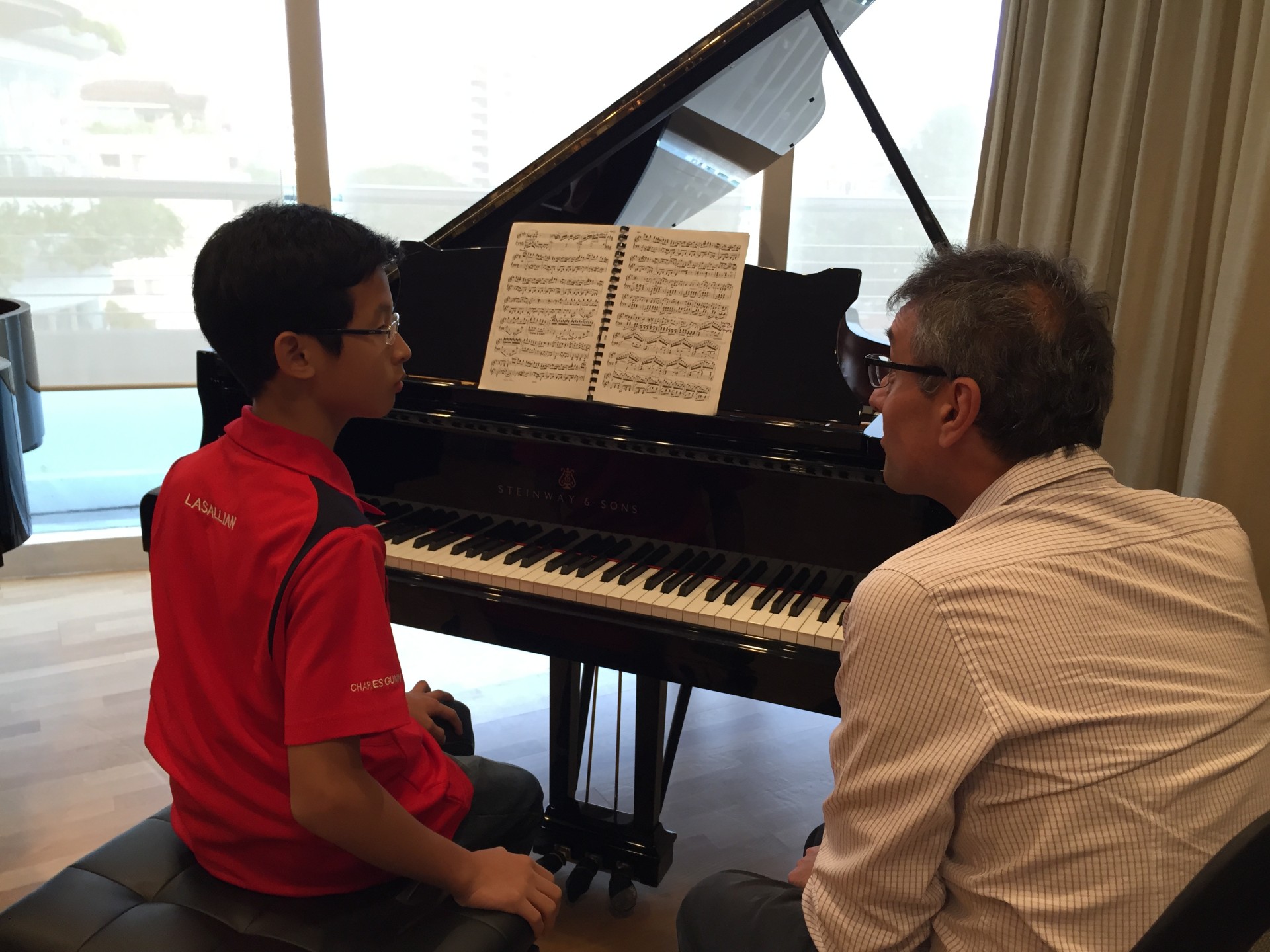
Just as importantly though, I encourage my students to take advantage of the many performance opportunities that are on offer. At RWCMD and RHUL, there are many opportunities for performances both inside and outside of college. I organise several concerts every year for my own students. The Annual Piano Competition at Eton is a spectacular marathon, usually about seven hours of really classy playing from over fifty boys. Most of my students take part and I also send them to performance classes, where they have the opportunity to play to another teacher and get some fresh ideas.
I am an adjudicator for the British and International Federation of Festivals and I really am a big fan of these events. It’s a wonderful way to try out repertoire in public in a relaxed setting and get some very good feedback from an adjudicator. Whether you are a complete beginner, a Conservatoire student preparing for a serious competition, or a terrified adult, these are fantastic opportunities and I can’t recommend them highly enough. It’s important to bear in mind that festivals depend on teachers and parents to help them keep going – the more we support them, the more they can help us.
Can you share a little about your approach to teaching the piano? Do you have a specific repertoire ‘plan’ for students as they progress, particularly with regard to technique?
Sometimes I say that my experience of studying in Russia taught me how not to teach, and although this is partly in jest, there is a grain of truth in it. It is absolutely essential to “read” and understand the student, to perceive their strengths and weaknesses, to encourage (without over encouraging), to criticize (without over criticising), and to open the door for them, to show them what is possible.
I have never really been a great fan of technical exercises. Eliso Virsaladze used to scoff at them and said that she found all that she needed in Mozart Sonatas. She was lucky enough to have a fabulous technique already, and of course, we are not all as fortunate as her, but I now increasingly appreciate their value provided that they are thought about deeply and carefully. I’m horrified when students tell me they warm up with them for an hour a day. Five or ten minutes of really focused practice is more than enough. I believe that a vast amount of technique can be dealt with through the repertoire itself. The sound that we produce is everything, and there is nothing more important than a relaxed yet strong posture. I have had students of all shapes and sizes, including an enormously tall young man, and it was a real challenge to find a comfortable position for him, especially his feet, particularly on a “low sitting” piano. If one is comfortable and natural at the piano it is immediately possible to achieve so much more, but there is no right way for everybody.
When learning a new piece, it’s important to consider which arm movements, gestures and fingering will suit the piece. Eliso was obsessed with a perfect legato fingering, involving many finger changes and substitutions. This can produce a wonderful tone, and I use it a lot, especially in slower music, but I am also keen on taking as many notes in a single gesture as possible, which is why I often think of the arm and hand movement before the actual fingering. And the eventual fingering has to be chosen with the hand size and shape of each particular student in mind. I think it is essential that we know what fingering we are doing on almost every note.
I ask a lot of questions in my lessons. (I don’t remember being asked a single question in three years in Russia – I was just given orders!). I want to know how the student wants to interpret a piece, and why, and I try to help them achieve this. I like it when my students disagree with my view and they manage to convince me that their way works. I try to treat my students like younger colleagues, and work collaboratively alongside them.
Harmony is the essential foundation on which all music is built, so I always discuss this with my students and the consequences that it has on a piece. They need to understand the structure and I recommend studying the score away from the piano (I do this a lot myself – it is amazing what one misses when one is busily working away at the keyboard, obsessing with fingering and pedalling etc…). It’s good to listen to recordings too, but not the first one that flicks up on your phone! Be selective and discriminating, and by all means listen before and after learning the piece, but maybe not so much during the learning process…

With some of my students after Stephen Hough’s performance at St David’s Hall, Cardiff
I always find it a refreshing and fascinating task selecting repertoire for a student. To choose the right piece for the right person at the right time is a definite challenge, almost an art form in itself. It’s wonderful when I get it right and the student loves the piece and they “fly” with it. It’s equally “un-wonderful” when I get it wrong. It’s always vital to put the student first, rather than choosing a piece I particularly fancy teaching! And equally important to never let them know that a particular piece they might want to learn might not be a favourite of mine.
I am far more concerned with student development in the longer term and it is so important that they treat concerts, competitions and exams as markers on the way, rather than ends in themselves.
You have been an ABRSM examiner for many years, what are the challenges associated with this job?
When I took my Grade 2 piano exam, possibly at half past four on some afternoon in 1976, it would have never occurred to me that the examiner might already have been sitting at their desk for the previous seven hours, assessing and writing at high speed about maybe twenty candidates taking different grades on different instruments. When I was being trained in 1999 by the legendary Clara Taylor (then Chief Examiner), she must have noticed me beginning to wilt in the mid-afternoon when a Grade 1 saxophonist walked in. With a smile she leaned over to me and whispered “Remember that this is the most important moment of their day, so it should be yours, too”. Great advice, which I remind myself if I have a little “wilt” these days. Examining has taught me skills in stamina, patience, organisation and multitasking – all to be delivered with a smile. Oh, and to have a light lunch (although Clara had a substantial lager with hers when she was training me!).
You are also an adjudicator for the British and International Federation of Music Festivals, how does this role differ from examining?
I love adjudicating at Festivals. I enjoy visiting different parts of the country and overseas, and becoming part of a musical “family” for a few days, hearing the performers, meeting teachers, organisers and parents. The musical world is so small and interconnected, I have very rarely been to a Festival where there isn’t somebody I know, or somebody who knows somebody I know. When adjudicating, I relish the opportunity to write freely (within reason!) and talk to the audience, ask questions, and if there is time, get some of the competitors to come back and play again and give a mini-masterclass. One has to be ferociously organised with timings and paperwork, but twenty five years of examining has helped me with that. I have also learned never to be surprised by anything, from “top end” playing, to the very opposite!

I had some of my first performing experiences playing in local festivals (in Grimsby and Cleethorpes in Lincolnshire), and I really am very supportive of them. Volunteers do an amazing job keeping these festivals going, and it bothers me that they are in short supply at times. I support my local Festival, the Stratford and East London Festival (incidentally, the oldest Festival in the UK) and hope to become more involved when time allows.
As a regular jury member on many international competition juries around the world, what do you enjoy most about this work and do you find that jury members generally agree regarding prize winners?
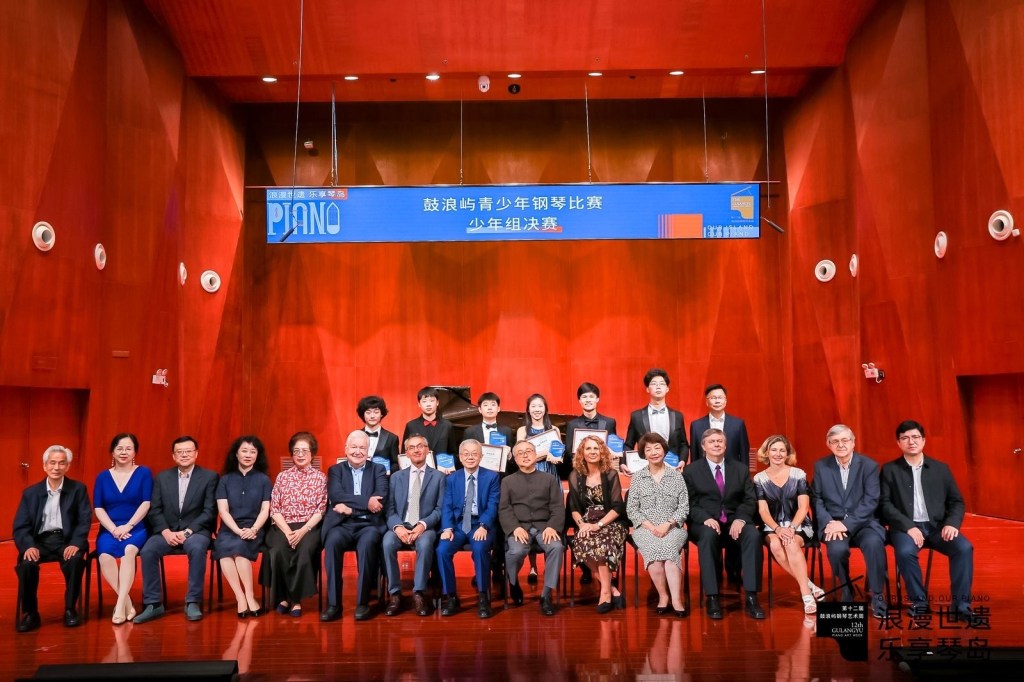
I have been lucky enough to serve on a number of international juries around the world. It is always wonderful and enriching to meet colleagues. Often, despite the demanding timetable of a competition, colleagues are more relaxed and less preoccupied and I have had precious opportunities to spend considerable time with distinguished colleagues. I have learned that it is important to seize the moment. Recently in Xiamen in China, I saw Piotr Paleczny, a highly distinguished Polish pianist, who serves on the Juries of many significant competitions throughout the world, and has a leading role in the International Chopin Competition in Warsaw. He had just given a magnificent all Chopin recital and I spotted him walking back to his hotel room, suit flung over his shoulder. I grabbed him and invited him for a drink and we had a wonderful chat for a couple of hours. In a similar vein, about 15 years ago I sat on a jury with the Russian pianist Viktor Merzhanov and heard first hand his stories about meeting Prokofiev and Shostakovitch and Russian musical life in the second half of the twentieth century.

Each competition has its own working rules. In an ideal world, I think that civilised discussion would be the best option, but there is a minefield of problems – language, strength of personality (I have observed some apparently quiet and decent people turn into monsters during discussions), time constraints, personal preferences, and of course, the dreaded “you help my student and I’ll help yours” syndrome, although I think that things are cleaning up on that front. There is a Chamber Music competition which I do in Latvia every two years, and my Latvian colleagues kindly allow us to discuss in Russian, so we are all speaking in our second language, which is pretty fair. It always works very well.
In Xiamen, there were twelve of us on the Jury. No discussion was allowed, and we had to write down our marks and hand them to a committee. They discounted the top two and bottom two marks and added up the other marks to produce the result. This seemed to produce a very fair result, and I, for one, was very happy.

In such a competitive field, what might be the most effective method for a young pianist to establish themselves as a performer today?
It certainly is a competitive field these days, I remember James Gibb told me that someone at the BBC had said to him “You play very well, you should do a Prom!” and he did! When I was a student Hamish said to me that he didn’t envy me as I started my career. Now I feel the same about my own students (without necessarily saying it!). Great talent is necessary, but even more important is the ability to harness and control it, to do the right things at the right time, not too much, not too little, understand yourself, your strengths and vulnerabilities, to deal with these, network (not too aggressively, not too passively), be nice (but not ingratiating) with your fellow colleagues – they will be your professional colleagues later.
Which live performances you have attended stand out for you as particularly inspiring, and have influenced your performing and teaching today?
Horowitz in the Royal Festival Hall in 1986. I swear to my dying day that he played a crescendo on the first note in the melody of Schubert’s Impromptu in B flat. And I spotted Shura Cherkassky in the audience, giving him a standing ovation.
And Cherkassky himself – amazing, unpredictable, totally bewitching. An incredible imagination yet with an extraordinary understanding of structure and harmony. Do listen to this recital from Stuttgart here including the encores. As well as some recitals to treasure, I went to an unforgettable Liszt 1 at the Royal Festival Hall:
Alfred Brendel playing both books of “Annees de Pelerinage” in London. If that wasn’t enough, he gave us Isolde’s ‘Liebestod’ as an encore. I have always hugely admired him for his perfect balance of thinking and feeling. I was lucky enough to get to know him a little when he came to play in Moscow, and he later gave me a lesson in London. Just last year, I played Mozart’s Concerto K503, and he was kind enough to send me his cadenza and give me permission to perform it.
Every year or so, my partner and I do the “Sokolov experience” and make an expedition to a different European city. Tickets are booked for Frankfurt next year! If you haven’t heard him live, it’s more than worth the effort…
Emil Gilels, Annie Fischer, Elisabeth Leonskaja, Sunwook Kim…..
Non piano……
Wagner’s Complete Ring Cycle at Bayreuth. The Borodin Quartet playing Schubert and Shostakovich in Moscow, Jessye Norman singing Strauss songs, Mariss Jansons conducting Beethoven and Tchaikovsky with the Pittsburgh Symphony Orchestra, Janine Jansen playing Sibelius…
What part of your overall work do you enjoy the most and what are your future plans?
I love all aspects of my work – playing, teaching and adjudicating, and feel that they truly complement each other. With performances, it’s always good to be asked back somewhere, and at my age, it’s also nice to play exactly what I want!
It gives me great fulfilment and joy that quite a number of my former students have become friends and colleagues and seem to be happy to keep in touch with me.
I am writing this on a train coming back from Newcastle upon Tyne, where one of my very first students at RWCMD has opened a Music Academy. I was delighted to attend the opening, and play alongside forty students (a most nerve wracking experience!) and give a masterclass the following day.
I am lucky enough to have a busy diary ahead and am looking forward to many more adventures.
Thank you so much for reading these interviews, and thank you Melanie, for publishing them so beautifully and being so patient with me! (I am painfully aware that I have almost completely rewritten this one at the very last minute…..!)

Top Image: Addressing a group of students in Almaty, Kazahkstan.

Wonderful! Thank you for this very enlightening and inspiring series.
Thank you, Barbara! I’m delighted that you have enjoyed it so much. Stay tuned, as there’s much more lined up for 2025.
Hello Melanie ,
I really enjoyed these interviews and I am convinced that James Kirby is doing very well in everything he does.
Thank you for posting!
Hi Martin, I’m really pleased that you’ve enjoyed the series. Yes, James is a star! There will be more in the series next year…