
Recently I’ve been working with a couple of students on a particular piece from my series Women Composers – A Graded Anthology For Piano. Both students, who are adults, are preparing it for a diploma exam. As this piece isn’t on the syllabus, it will form part of their ‘own choice’ exam repertoire, of which they are able to select up to ten minutes. This is a handy ‘rule’ allowing pianists to veer off-piste. A few personal choices can make all the difference in terms of programme variety and pupil satisfaction. Students don’t always enjoy the set pieces on various selected syllabuses, and they prefer choosing their own works.
On the subject of exam syllabuses, it’s worth mentioning that five works from my three-book Women Composers Series have found their way onto the new ABRSM 2025 – 2026 syllabus: ‘Allegretto Moderato’ by Elfrida Andrée features in Grade 3 (from Book 1), ‘Gavotte’ by Cecil Chaminade is on the Grade 5 syllabus, ‘Allegretto’ by Anna Severine Lindeman, on the Grade 6 syllabus, and ‘Children’s Song’ by Maria Görres is on the Grade 7 syllabus (all from Book 2). Children’s Song was a wonderful discovery and is one of my all-time favourites from the whole series, so I’m pleased that candidates will now be introduced to it. Teresa Carreño’s ‘Plainte’, or Elegy Op. 17 No. 1. (from Book 3) can be found on the new ARSM performance diploma syllabus too. You can find out more about my books and music featuring in examination board syllabi, by clicking here.
When editing piano books, one of the trickier conundrums is how to finger a piece of music effectively, that is, writing into the score which fingers play which notes. I do a lot of this, both in terms of fingering piano pieces for my students as well as for all my piano books.
At the start of working on any new ‘anthology’ style publication, first comes finding suitable music – and the research for this can take a while – and next comes the all-important task of annotating the scores. This is done before writing any practice or teaching notes. I spend a considerable amount of time doing this. Recommending suitable tempi is the first challenge as the tempo that I might choose to play a piece will not necessarily be the same as that played by a student. For this reason, my scores tend to offer wide-ranging metronome markings as a suggestion, so that teachers and pupils can ultimately make their own choices.
Pedalling is fairly easy to add but fingering isn’t. After all it’s a personal choice: everyone’s hand shape is different and what suits an adult will not necessarily suit a small child. But it must be added. My articles and books are mostly ‘study’ editions for students and, therefore, there is an expectation for a fully annotated score. I often prefer to add two options for fingerings in more complicated passagework. However, publishing houses generally aren’t keen on this approach. So, decisions have to be made. In such cases, I will go with the ‘obvious’ option, as if I don’t, without a demonstration, my preferred fingering might be perceived as illogical or just too difficult.
A case in point can be illustrated in the piece my two students are playing from the Women Composer Anthology for their exam. The beautiful Prelude in D flat major, written by French composer Lili Boulanger, features in Book 3 of the series. My suggested fingering written in the score is sometimes pedantic. It follows the suggested norm for larger chords. Why didn’t I include more useful fingering? Because students with small hands and those with tension issues might struggle with it and may hurt themselves. Good fingering sometimes relies on a teacher demonstrating how that fingering works in practice, especially when it doesn’t, on the face of it, appear logical.
After surveying my printed fingering, I advised my students to change it and do something slightly different. Neither student was happy with their legato line during some of the chordal passages. Finding a secure legato approach joining chords via use of the fingers is a highly beneficial technique to learn. The following two chords (moving from bar 5 to 6 in the Prelude) are fingered like this in the book (Example 1), and we swapped it to that in Example 2, changing fingers on the second chord in both hands:


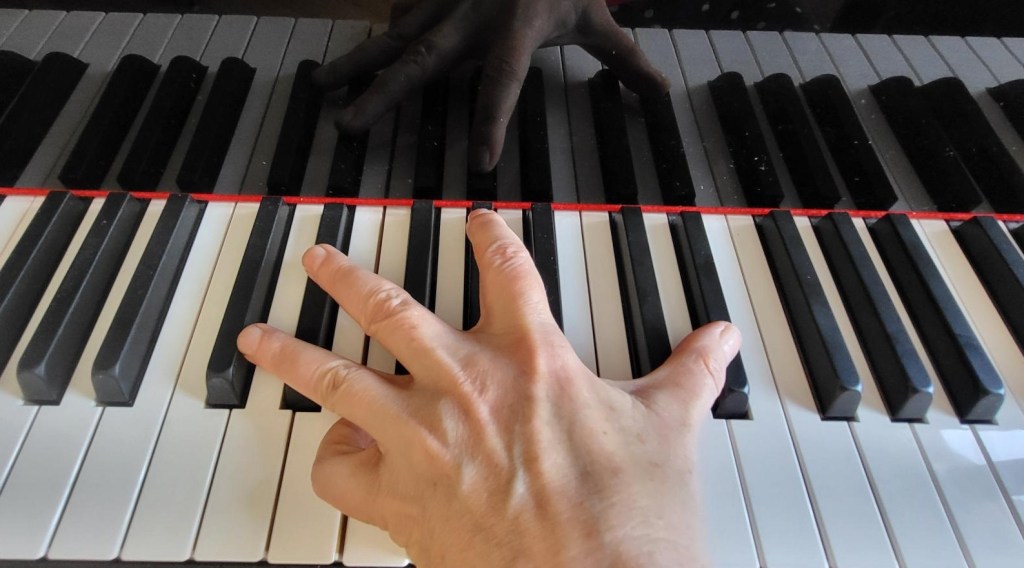
This new finger option in the right hand (RH) allows the fourth finger to hop over the fifth (from the A natural to the B flat on the top note), keeping the fifth in place until the fourth finger has sounded the B flat – a comfortable position for the larger hand to play, with the white note moving to a black. However, this movement requires a relaxed, flexible hand. It usually needs a couple of spot exercises for students to ‘prepare’ for such a movement. Additionally, it demands a quick release of the lower notes in the first chord (the E flat and A natural) to move into position for the lower F and B flat on the second chord.
Left hand (LH) chords can also be joined here too, if the lower F in the first chord (played with a fifth finger, as suggested) is followed by the fourth finger on the D flat lower note (using a 1, 2, 4 on the D flat, A flat and D flat). These chords can, of course, be ‘joined’ by using the sustaining pedal, but creating a legato line using the fingers is always preferable.
To create legato, students need plenty of swift tension-free movement. With this in mind, we ensured that they were prepared for such a large out-stretched movement with a few choice exercises. The result: two ‘joined’, smooth legato chords for which the sound will be easier to control and one that is not completely reliant on the sustaining pedal. You can see how this might work from the images below in the RH (Photo 1) and LH (photo 2).

One of my students loved this fingering and the other chose to stick to that written on the score. Fingering is a personal affair and it’s worth exploring all options. Sometimes it’s a good idea to go against score editors (!) finding your own solution and one which better suits your hand and comfort level.
Hear Lili Boulanger’s Prelude in D flat by clicking on the link below:
Find out more about my series here: Women Composers – A Graded Anthology For Piano
Top Image: Lili Boulanger: Alamy

Thanks again Melanie for this interesting article!
Yes, the correct position of the fingers is not always easy. I always start with the indicated notation. If it feels a bit difficult, I will change it to what feels more comfortable to me, but this does not happen much because I think that the indicated fingering has been extensively tested by the composer and also by you.
But indeed, everyone’s hands are different. It is certainly worthwhile to first follow the indicated notation.
For me it is a challenge if there is nothing at all on the score, then it takes some searching and this takes time but is not insurmountable.;-)
Best wishes,
Martin
Hi Martin, Many thanks for your comments. I’m glad that you enjoyed the article. Yes, it’s certainly a challenge if there isn’t any fingering on the score to start with – but fortunately, few are this naked! Melanie