
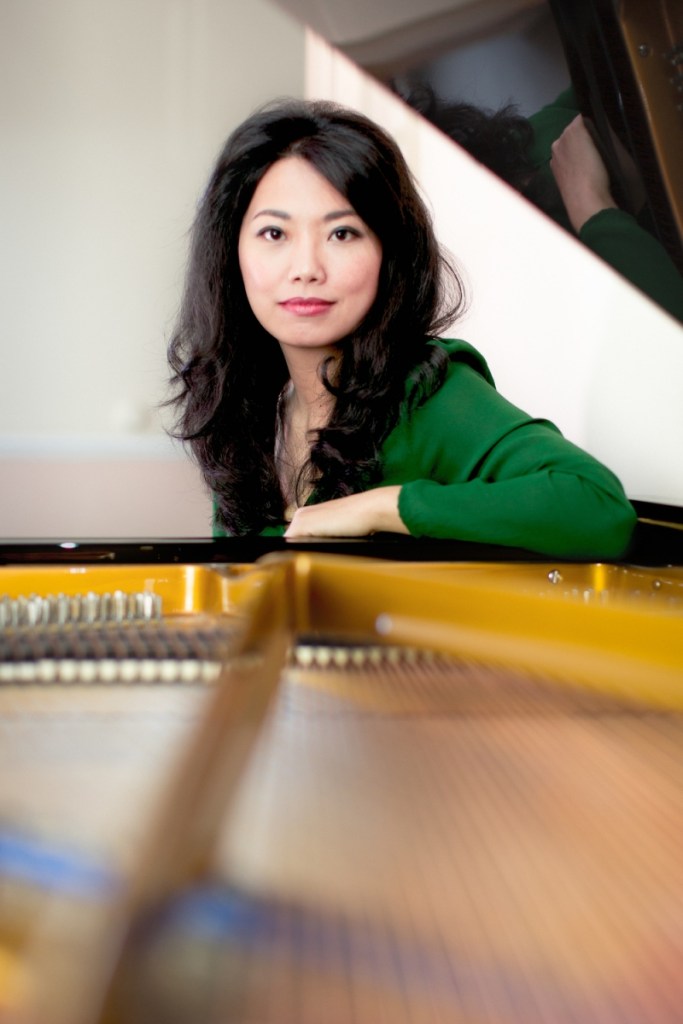
I’m continuing the popular ‘Piano Pedagogy Series’ on my blog today featuring the first of four substantial interviews with Chinese concert pianist and teacher Chenyin Li.
Chenyin enjoys a busy concert career and, since 2011, has contributed to nearly 90 CDs and dozens of video performances as the exclusive pianist for Pianist Magazine. She is a piano faculty member at Junior Guildhall School of Music and Drama in London and Visiting Professor at the University of the Chinese Academy of Sciences (UCAS) in Beijing.
This interview focuses on Chenyin’s training, background and education.
Tell us a little about your background. When did you begin your piano journey and was there a particular reason that you started piano lessons?
I was born in China into a family with no musical background at all — not even within the wider circle of relatives. Yet perhaps it was written in my name: in Chinese, ‘Chenyin’ translates as “morning music,” and it seems fitting that music would eventually become central to my life.
How I first came to learn the piano is an interesting story. When my uncle had just become engaged to my aunt, he decided to buy her a wedding gift — not something practical, but something romantic: a second-hand upright piano, purchased from a neighbour who was emigrating to Hong Kong. This was in the early 1980s, shortly after China had emerged from the ten years of the Cultural Revolution, when Western culture and art had been banned outright and regarded as sacrilegious. To own a Western instrument at that time was rare and, in many ways, remarkably brave.
My uncle had spent so much money on the piano that he couldn’t afford to buy a house, so the instrument ended up in our family’s living room “temporarily” — in fact, it stayed there for the next five years. My mother, who had always loved singing, thought it would be fun to learn a few tunes, even at an amateur level. And so the piano became part of our daily life, quietly but profoundly setting me on the path towards music.
Who was your first teacher, for how long did you work with them and how did they shape you as a musician ?
My first teacher was a wonderful local pianist who also worked as the official accompanist for the local ballet company. Looking back, I don’t think he was a highly trained performer himself, but what he gave me was perhaps even more valuable: he poured his enthusiasm for music into me from the very beginning. I still remember him saying to me, more than once, “Treasure this time — you are so young, and you could really become a professional pianist one day.” I suspect, like many from his generation who were denied the chance to study Western instruments formally during the Cultural Revolution, he had largely taught himself, and this gave his encouragement a special sincerity.
That very first lesson was unforgettable. Before I was even allowed to sit at the piano, he asked me to bow to it, as if to acknowledge the instrument with respect. It set the tone — lessons were always a mix of seriousness and drama. At the time, both my parents were working full-time, so I actually learned to read music with the help of our house assistant. My teacher taught my mother, who then passed it on to her, and she would sit beside me and sing, for example, the right-hand notes in solfège while I played them back on the piano. That was how I first learned to read notation.
In the end, I only studied with him for a year before he moved to another city, but those short months planted the very first seeds of my musical journey.
You studied at the China Conservatory of Music in Beijing with Professors Zhong Hui and BiGang Chen. Tell us a little about your experience?
My conservatory years began unusually early. At the age of eight I was very fortunate to be accepted into the Central Conservatory of Music in Beijing — at that time regarded as the most prestigious musical institution in China, almost a ‘holy grail’ for any aspiring musician. It was about 400 miles from my home province of Shanxi, and the move marked a decisive break from my provincial beginnings.
The name is slightly misleading: in those days the conservatory housed not only the undergraduate and postgraduate departments, but also its affiliated schools for highly gifted children from the age of eight onwards. In practice, it functioned as one vast institution for musical training, nurturing pupils from their very first steps right through to professional level.
The admissions process was notoriously competitive. My father happened to see an announcement that the conservatory had lowered its entry age to eight, and he encouraged me to audition, thinking it would simply be good experience for the future, as I was technically a year too young to qualify. In the end, that “trial run” changed everything. The conservatory accepted only four piano students from across the whole country that year, through four rounds of auditions: two based on performance, followed by academic exams, and finally a medical check-up.
To my astonishment, I was admitted on my very first attempt.
For six months I lived with relatives in Beijing, practising six to seven hours a day under the guidance of conservatory teachers. One of them, Professor Zhong Hui, later became my formal teacher, and she was the one who truly brought me to the threshold of professional training. It was an incredibly demanding period — I can still remember how difficult it felt at such a young age. To give some idea of how selective the process was, the majority of talented young pianists auditioning would be turned away each year, sometimes repeatedly.
Later, I studied with Professor Bi-Gang Chen, who belonged to the very first generation of Chinese musicians sent abroad after the founding of the People’s Republic in 1949. He had studied with two prominent Russian pianists, Boris Zaharov and Boris Lazaref, and he carried that lineage directly into his teaching. Changing to his class came at just the right time, as I was entering my teenage years. His teaching was not confined to the hard training of his study — often it extended into his own home. He would regularly gather groups of his pupils there, and on his carefully assembled high-quality stereo system we would listen to whatever great Western performances he had managed to obtain.
It was in his living room that I first encountered many of the legendary pianists of the so-called “golden age”: Rubinstein, Horowitz, Wilhelm Kempff (his personal favourite), Alfred Cortot, Glenn Gould, and many others. At that time, so many of these artists, who were household names in the West, were still scarcely known in China. There were very few recordings or LPs available, and almost none were widely distributed until the 1990s.
The doors that Professor Chen opened for me through these sessions went far beyond daily routine. They truly broadened my horizons, giving me a first sense of what artistry could mean. Much of my earliest training had been centred on establishing and polishing the technical foundations of the instrument, but with him I began to glimpse the deeper world of interpretation and musical imagination.
What are your first performance memories?
My first performance memories fall into two very different categories. When I was very young and had just begun to play little tunes, my parents would immediately urge me to “perform” them — whether to the family or to any house guests who happened to visit. However short or simple the pieces were, they had to be played as complete performances: always from memory, and without any interruptions. By “mistakes” my parents meant not small slips, but anything that disturbed the flow of the music, such as stopping or repeating a passage. Only much later, when I began teaching myself, did I realise what an important principle this early training had established. Too often I hear even advanced students fall into the habit of repeating or correcting themselves mid-performance, breaking the musical flow. That early insistence on continuity gave me a discipline that has stayed with me ever since.
My first ‘proper’ public performance came a few years later, at the age of twelve, in the form of a kind of “graduation” recital marking the move from Year 6 to Year 7 — the beginning of secondary school within the conservatory. It wasn’t part of the official curriculum, which required two end-of-year recital programmes and a technical examination, but I wanted to prepare an additional full programme of my own. I still remember working extremely hard for it, and in the end I gave a one-hour recital which included a collection of Grieg’s ‘Lyric Pieces’, Debussy’s complete ‘Children’s Corner’, and Beethoven’s Sonata in D major, Op. 10 No. 3.
Did you enter many competitions as a young pianist?
I did enter competitions as a young pianist. Before the age of twelve, I twice won different editions of the “Xing Hai Cup,” which at the time was the biggest competition in Beijing. As the capital’s main event, it was regarded as a competition of very high calibre. To be honest, I don’t have especially vivid memories of those early contests — I prepared for them much as I would for any other public performance, and I was fortunate to win.
Those experiences were really only the beginning of what later became a longer journey into larger national and eventually international competitions. Competitions are something many musicians have a love–hate relationship with, and I think I felt that even then. But the most important lesson I took away — and something I still remind myself of — is that whatever the result, I should treat everyone, including the jury, as my audience. In the end, they are listeners to be communicated with, not judges to be feared.
Do you feel that the competitive element is helpful in a young pianist’s journey as a musician or is it detrimental?
I don’t think there is a single answer that fits all artists. So much depends on temperament, character, and even the type of repertoire one wishes to specialise in — all of these shape a musician’s path differently. For me personally, competitions were very much like the saying: ‘what doesn’t kill you makes you stronger’. However limited, biased, or at times even plainly unfair they may be, they provided me with exposure and opportunities. Coming from a distant province with no background or reputation, I was eager to be heard by a wider audience, and competitions made that possible.
Through participating, I also encountered many supportive artists and fellow pianists, some of whom went on to help me in different ways later on. In principle, and with the benefit of hindsight, I see that the experience — with all its positives and negatives — gave me invaluable lessons, both in life and in music.
What was the most important advice you were given as a young pianist?
If I were to give one piece of advice to young pianists, it would be very simple: practise! It sounds obvious, but there is really no substitute for it. I’ve never fully subscribed to the idea of the “10,000 hours rule”, as I believe that this is not even enough for the piano. What matters is practising with both intensity and intelligence, and allowing yourself to become absorbed in the process. Without that level of commitment, true progress is impossible.
One of the challenges today is that young people are surrounded by countless “worthy” distractions: rapidly developing technology, a wealth of extracurricular activities, and busy academic schedules. What often gets lost in all this is the time to linger, to slow down, to immerse oneself completely in the perfection of a tiny detail, or to shape a single phrase with real patience. Too often there is the temptation to move on too quickly.
My advice would be: don’t be afraid to stay with one passage, repeating it hundreds — even thousands — of times if necessary. There is a Chinese saying, ‘Di Shui Chuan Shi’: a single drop of water can eventually bore through rock. For me, that perfectly captures the spirit of real practice.

Hi Melanie, she’s so good !
I enjoyed her piano playing very much.
And I will mainly remember the saying: ‘Di Shui Chuan Shi’.
Thank you for posting ! 😉
Hi Martin, Yes – Chenyin is a wonderful pianist. I’m really glad that you enjoyed the post – keep an eye out for the other three in the series, as there will be a lot more videos of Chenyin’s piano playing in them all. Melanie 🙂
Chenyin Li, you are quite a candidate to interview.
Definitely, William! I thoroughly enjoyed interviewing Chenyin! All the best, Melanie