
This is the second interview with concert pianist and piano professor James Kirby. In our first interview, James spoke about his time studying the piano in the UK. In this second interview, he focuses on his experience as a student in Russia.
Why and how did you come to study at the Moscow Conservatory in Russia?
The very word “Russia” has always felt faintly onomatopoeic to me – it fascinated and intrigued me and had a palpable sense of magic and mystery. I had always been drawn to the incredible tradition of Russian music making – that gorgeous richness of tone of Richter, Gilels, Oistrakh and Rostropovitch and those golden days of the Leningrad Philharmonic playing under Mravinsky. I loved the feeling that music in Russia was a treasured and valuable tradition and a natural part of everyday life. In 1986, the pianist Tatiana Nikolayeva made a very rare visit to London to play the complete Preludes and Fugues Op. 87 by Shostakovitch, which were specially written for her. She was performing in a rather strange venue, the Octagon Room in Christies Auction House. I remember a sense of real excitement in the audience – she was something of a legend in the USSR, but little known in the West then. It was a wonderfully rich performance, generous in spirit and she spoke from the platform with great love and reverence for Dmitri Dmitriyevich.
Rather naively I joined the queue backstage and asked her if I could come to Moscow and study with her. She didn’t speak English, but nodded and smiled politely and moved onto the next person. I was smitten though, and cutting a long story short (there were endless bureaucratic/visa problems and delays) in September 1987, thanks to a British Council Scholarship, I found myself on a British Airways flight to Moscow with a return ticket for the following July.
What was your experience of living and working in Moscow during the 1990s?
I landed in Moscow and was immediately struck by the darkness and gloominess of the airport and the smell of cheap cigarettes and petrol. I was taken in a battered minibus to the student hostel (the “obschizhitie”), which was to be my home for the next three years. A five storey building, ubiquitous in the USSR (known as a “Kruschevka”), reasonably near the centre, within earshot of the Zoo, it was the home of five hundred students – those from the remoter regions of the USSR, a smattering of “westerners” (just three Brits) and many others from all over the world, particularly China, Vietnam, South America and Eastern Europe. I shared a room on the top floor with a pianist from the Ural mountains, (let’s call him Sasha). The room was spartan, to say the least, although we did have the luxury of an (awful) upright piano. We had a bed and a bookcase each, and when I had unpacked I was immediately embarrassed by all the western riches on my shelves compared to the modesty of his. Sasha was a very fine pianist, but we both agreed that it was uncomfortable to practice in a tiny room in front of each other so we organised a timetable so we could practice when the other one was out.
The other practice possibility was the “repetitory”, a dingy suite of rooms in the basement, presided over by three ladies of varying ferocity who held the keys to the rooms. To practice, it meant joining a queue at 6am to book a room. One, Auntie Panya, was easily bribable, the Armenian lady was unpredictable, but the fiercest one was totally immoveable and unforgiving (we called her the “Stalinistka”). The best way to describe the quality of the pianos would be “quaint” – there was one particularly interesting room which had the case of a grand piano, but there was no mechanism inside.
There was a unique friendliness and sense of comradery in the hostel. People always greeted each other in the corridor with a friendly “Priviet”, quite often accompanied with a formal handshake, and, as there were considerable food shortages in Moscow at the time, there was an unspoken rule that you could knock on your neighbour’s door and “borrow” some butter/milk or whatever, and your neighbours would expect the same of you. Sasha clearly felt pity for me and took me under his wing. We established a routine of eating twice a day. An enormous omelette for late breakfast (after some bleary eyed practising at 6am) with onion, sausage, parsley (when available), far too much butter and salt. Or perhaps kasha (Russian porridge made from buckwheat) with cherry jam, made by his mother the previous autumn, lovingly preserved in large (almost impossible to open) glass jars. Sasha was fascinated by my easy opening screw top jars of Golden Shred marmalade, purchased at the British Embassy shop.
We had an early dinner, often sausage (again) and potatoes. Vegetables were a rare luxury, and most fruit disappeared from the shops between October and April. Six months without a single tomato was difficult.
There was a cafeteria on the ground floor, but it was so revolting that I only used it a handful of times in three years. Students clubbed together in groups and we cooked delicious feasts, washed down with cheap champagne (£1 a bottle) and vodka. Many of us changed money on the black market and my “contact” in a taxi rank would sometimes sell me a kilogram jar of black caviar (£10!). Sasha was fantastic at making industrial quantities of blini, and together with a large tub of sour cream, we did extremely well for ourselves.
There were some strict rules in the hostel, and the Commandant was very unpredictable and sometimes aggressive and it was essential not to cross her. For some unfathomable reason, we were not allowed to lie on our beds with our coats on. There were “Working Saturdays” (“Subbotniks”) when we had to sweep the corridors and clean the kitchens. The refuse system in the kitchens was unique – there was simply a hole in the wall, into which you threw your kitchen waste. It went down a huge chute down the side building and ended up in a heap at the bottom. This pile was cleared up occasionally. It was not so appealing when several months of rubbish thawed after the winter freeze. The toilets were beyond description – we joked that they improved peoples thigh muscles and actually I think I have the occasional nightmare about them to this day. Bed sheets were changed every two weeks, but heaven forbid if you missed your turn, and occasionally the laundry would be closed and padlocked for days on end. There was also a challenging period for us in early summer when all the hot water was turned off for a month to clean the pipes. There was an even more interesting time in my final summer, in a heatwave, just when I was preparing for the Tchaikovsky Competition, when both the hot and cold water was closed off for a week or so…..

Inspecting the Mammoth museum in Yakutsk, Siberia. Temperature of minus 38 degrees.
As well as making all kinds of friends in Moscow, I was lucky enough to have some wonderful links with the British Embassy. Sir Rodric Braithwaite, the Ambassador, was at the height of a very distinguished career. He often invited us to the Embassy and we had many happy lunches, dinners (including Christmas festivities). Sir Rodric was a keen amateur viola player, and we had some delightful chamber music sessions. Once I remember him suddenly glancing at his watch and rushing off, in horror saying “I’ve got a meeting with Gorbachev in a few minutes!” We were always invited to the QBP (“Queen’s Birthday Party”) and I met Helen Sharman, Britain’s first astronaut. We remain friends to this day.
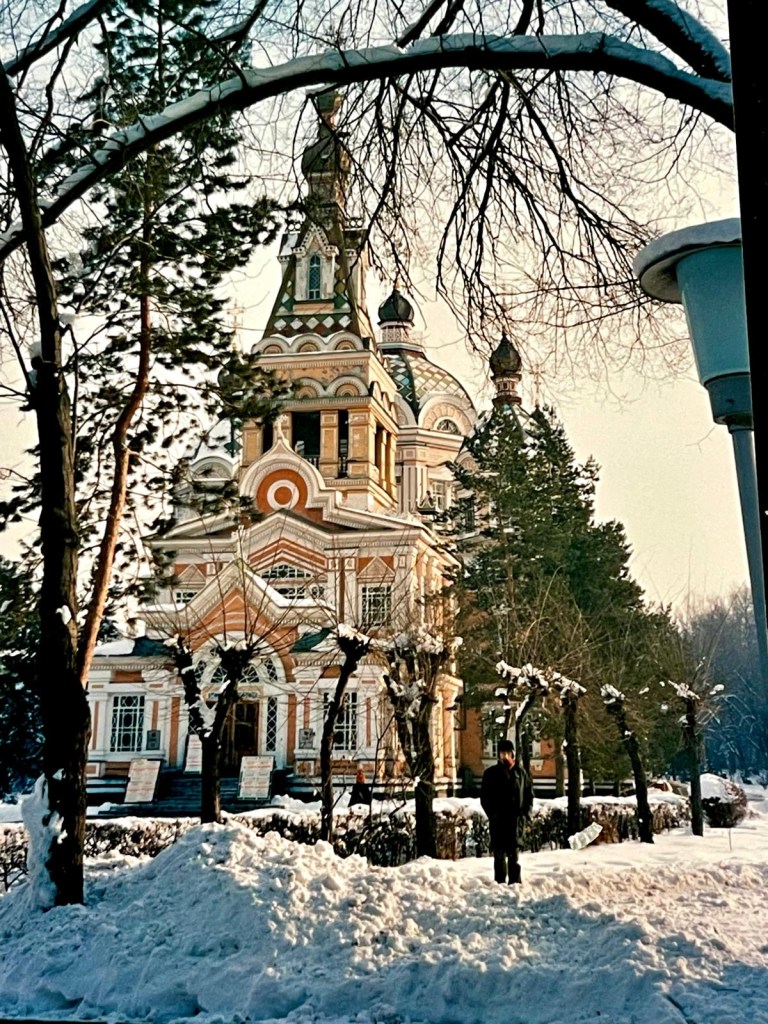
During these three years in Moscow I got to know it incredibly well. I loved walking (I still do) and I explored literally everywhere. I also took every opportunity to travel outside of Moscow and went to very many cities – highlights perhaps being Almaty (11 times!), Magnitogorsk (the most austere place I have ever been) and Yakutsk (the coldest place I have ever been). As foreign students we were supposed to acquire a visa if we left Moscow, but sometimes we travelled “illegally” on the train to Leningrad (whisperingly calling it “Peter” or St Petersburg – never imagining that within a few years the city would indeed revert to its original name). My friends told me to wear my hat low, and not speak to the train guards and pretend I was a Georgian.
Who did you study with in Moscow? What were classes like there and how did they differ from those at the RAM?
I was accepted into the class of Tatiana Nikolayeva – she taught in Room 43 – one of the more magnificent large rooms in the Conservatory. She would sit under a marble bust of her teacher, Alexander Goldenweiser. Lesson timings were mysterious – she would come into the Conservatory, often armed with a bag of shopping, plonk herself down on the sofa and teach for the whole day. Sometimes the room was packed with students. Immediately noticeable was the young 14-year-old Nikolai Lugansky, who already played better than the 23 year olds. A few months ago I went to his (magnificent) Rachmaninov recital at Wigmore Hall and went backstage. “You won’t remember me, but…” “James, yes, I remember you! You played the original version of Rachmaninov’s Second Sonata!”. And indeed I had. What an amazing memory after thirty five years!

Nikolayeva’s teaching was quite general, and she didn’t seem to like hearing the same work more than once. I found that I was learning fast and furiously in order to prepare a new piece for each lesson, and I really did need to work in more detail. I liked her very much and loved her playing, but made the difficult decision to change teacher.
Some years earlier, I had been absolutely blown away by a recital by the Georgian pianist Eliso Virsaladze – it was at the Alte Opera, Frankfurt, and it was one of those recitals which I can still hear in my head today. In Moscow, she only had a small class, and I was incredibly lucky to be able to study with her. She taught at home, in her modest flat, with two fairly ordinary grand pianos. Lessons were often at 8am, which in winter involved an unpleasantly early start, an awkward bus and metro journey and a walk through the snow at the end. Lessons were enormously strict and hugely detailed. Once, when Eliso was interviewed about her teaching philosophy, she said that she taught “to exhaustion”. I spent the next two years wondering whether she meant the teacher or the student, or possibly both. Praise was extremely rare, and she was always very critical. To some extent, I was lucky to be cushioned by being criticized in a foreign language. She was obsessed with legato, phrase direction, clarity of textural layering and a certain kind of rhythmical freedom, qualities which she possessed in abundance herself. I would say that she was a strong, even forceful personality, and there was very little discussion. There was a tendency therefore, for us to imitate, and of course we sounded fantastic, but in hindsight, I’m not sure that we sounded like ourselves. When I listen back to recordings of myself from that period, I get a rather strange impression.
It was such an exciting time, as I was in an incredible class, alongside Boris Berezovsky, Aleksandr Madzar and Roustem Saitkoulov. Hamish Milne had always advised me to be involved with musicians “better than myself” and, although daunting, this had certainly happened.
I had decided to take part in the International Tchaikovsky Competition in 1990. On paper, this was completely mad, as I had never done a big competition before, and Eliso must have thought so too, but she allowed me to do it, we rolled up our sleeves and got to work. Boris was doing the competition too, and there was considerable expectation that he might well win. It was incredibly exciting for me to join the ride.

I started learning the repertoire around a year before the Competition. In the First Round, I offered Bach Prelude and Fugue in A flat Book 2, Beethoven Sonata in E flat Op 27/1, three pieces from Tchaikovsky’s “Seasons” (January, May and November) and four etudes (Chopin Op 25/10, Scriabin Op 42/1, Rachmaninov Op 39/6 and Liszt’s Gnomenreigen). It turned out there had been no selection process for the first round and 190 people had entered the competition. Even after the first round was shortened, the Jury had to listen for ten hours a day for two weeks. There was a distinguished jury, led by Tatiana Nikolayeva (my FORMER teacher!!) and many professors from the Moscow Conservatoire, including Viktor Merzhanov (I was lucky enough to sit with him on a Jury twenty years later – do listen to his Rach 3, by the way, one of the very best performances I have heard), Evgeny Malinin, Sergei Dorensky, Vladimir Krainev, Lev Vlasenko and Mikhail Voskresensky. James Gibb, then Head of Keyboard at the Guildhall School of Music and Drama in London was on the jury, and after the competition I came to know him quite well and had some wonderful lessons with him.

A rare hug from Elisso Virsaladze after my performance at the Tchaikovsky Competition.
I remember playing quite well in the first round and to my surprise and joy, found myself in the semifinal. This was a very tough hour long recital. Realistically I knew this was probably the end of the road but I gave it my best shot and played the first movement of Schubert’s C minor Sonata, Khudoley’s Sonata-Fresca (the compulsory piece, and the very devil to memorise), Tchaikovsky’s Dumka (which Eliso hated), and Prokofiev’s Sixth Sonata. Then there was the excitement of listening to the final, willing on Boris, and going back to Eliso’s flat for the agonising wait for the results.
Comparing the two conservatoires, which did you find most useful in terms of pianistic training and did you find many performance opportunities in Russia? As you had the opportunity to experience Russian piano training first hand, can you share the ethos behind this specific approach.
I think I was very fortunate to have had my time with Hamish Milne at the RAM (he gently prodded open doors and let me wander through for myself at my own pace), whereas in Moscow I felt I was catapulted through the doorway! Perhaps it was good to have had both ends of the spectrum – maybe Hamish’s way would be too relaxed for some, but it suited my temperament better. I sometimes joke that Russian teaching is done “through fear” but sometimes this feels not far from the truth. It certainly does produce results, and sometimes I do wonder if we are sometimes a little too laid back at home.

With my Kazakh “family”.
Wonderful performance opportunities opened up for me during my time in Moscow. I made a close friendship with the Kazakh violinist Marat Bisengaliev, and thanks to him I visited Almaty many times and we played solo, duo and chamber music concerts as well as concertos with orchestra. I was introduced to his large family and welcomed into it. It is one of my most precious experiences during that time.

I also went to perform in the Baltic States, Belarus Ukraine, the Urals and Siberia. After my student years I returned to the Former Soviet Union many times, highlights being concerts at the Sakharov Festival in Nizhny Novgorod, the Omsk Festival, and opening the season of the Moscow Symphony Orchestra, playing Beethoven’s Fourth Concerto in the Great Hall of the Moscow Conservatoire. I formed a close relationship with the Rachmaninov Institute in Tambov and visited many times to perform and lead chamber music courses.

In Part 3, we discuss James’ career as both a soloist and chamber music player.
Top Image: The Grand Hall of the Moscow Conservatory

A fascinating story, thanks Melanie! 😉
Thanks, Martin! I’m so glad that you’re enjoying the series. 🙂