
I’ve just returned from my second trip to the Far East this year. I love these adventures to far-flung exotic destinations and I feel it a privilege to travel for my work.
Despite having worked in Singapore and Hong Kong on numerous occasions, I hadn’t visited since just before the pandemic in 2019. One of the reasons for travelling is to promote my books and this trip was no exception. The current trend to only market one’s wares online is no doubt extremely helpful for many, but, for me, it’s somewhat missing the point. I relish the opportunity to create and deliver educational piano workshops and classes because it affords the chance to work closely with teachers and students, allowing first-hand illustration of my publications, with the added possibility of demonstrating why they could be a useful addition to a pianist’s piano library.
In Singapore, I was given carte blanche to develop a two-day piano teacher training programme for the Cristofori Music School, who employ several hundred piano teachers to teach at the school; the academy is attached to Cristofori’s music shops of which there are over 35 in Singapore. Developing such a course was as fun as it was daunting. My classes lasted four hours each day, and I also gave a master class or a series of public lessons to a group of students from mainland China.

Day 1 was devoted to four piano technique workshops. Each one lasted approximately an hour, beginning with really simple five-finger exercises, intended to develop physical flexibility in the upper body whilst creating firmer fingers alongside honing an ideal tone or sonority. This may sound rather complex what with the combination of many techniques at once, but the exercises are very slow-paced and so easy and engaging that teachers and students enjoy trying them out at the piano, and I’m never short of volunteers – quite a feat in the Far East, where teachers, particularly, are notoriously shy.
Following on from the first workshop, we next address the more expected technical issues throughout the remaining three. These presentations are generally well-received, to the point where I’m frequently contacted by workshop participants after the event, who wish to report on the progress of their students whilst using my exercises.
Day 2 focused on other aspects of teaching, namely how one might approach teaching selected graded exam repertoire from the current RSL Classical Piano syllabus, which is the examination board of choice at Cristofori, as well as a ‘guided tour’ of my books, Play it again: PIANO (Schott Music) and the Women Composers – A Graded Anthology For Piano (Schott Music).
Day 2 focused on other aspects of teaching, namely how one might approach teaching selected and graded exam repertoire from the current RSL Classical Piano syllabus, which is the examination board of choice at Cristofori, as well as a ‘guided tour’ of my books Play it again: PIANO and the Women Composers Anthology (both published by Schott Music).
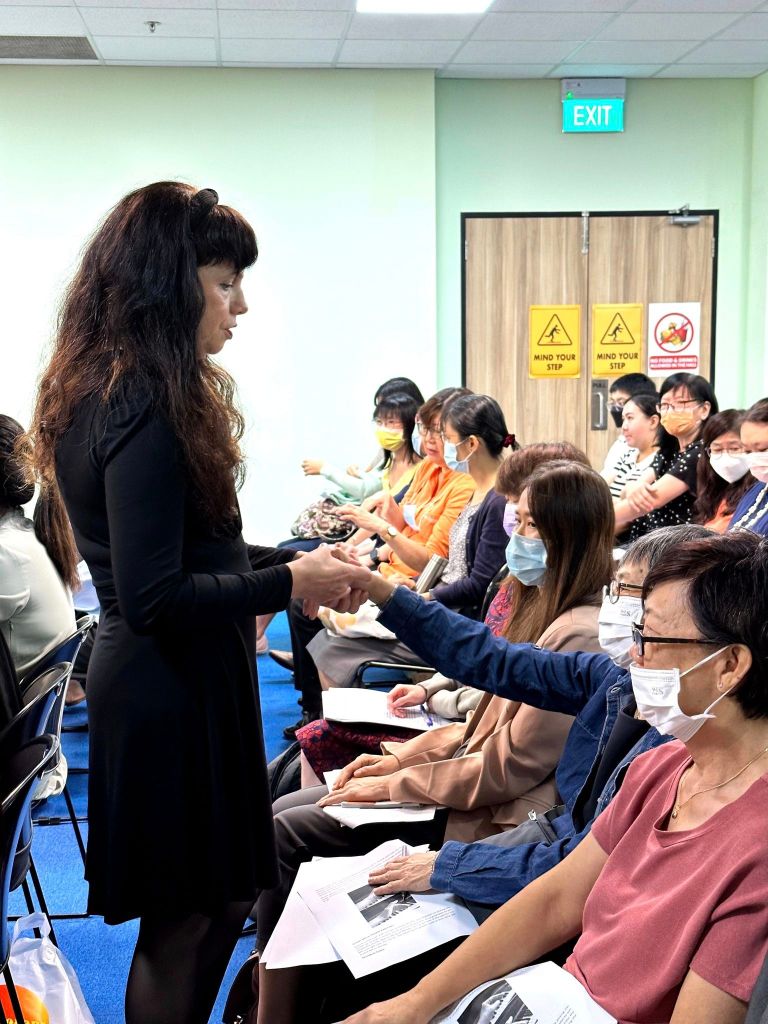
Day 2 also featured a teacher performance class, where teachers played repertoire pieces from exam syllabuses as well as from Play it again: PIANO, and we talked about various ideas and teaching suggestions.
The last class was devoted entirely to sight-reading, and this is where the fun started. Whilst I take teachers through a few, what I consider to be, important reading concepts, the main attraction is the opportunity to play together on several pianos, hopefully illustrating that this much maligned subject can be enjoyable. The repertoire I chose for this activity consisted of three of my piano trios (6 hands at one keyboard) from Snapchats Duets & Trios (80 Days Publishing). Fortunately, Cristofori is based at Bechstein Music World, in the heart of the business district of downtown Singapore, so we had the chance to use all the pianos in their showroom; 54 teachers playing 18 pianos was quite something. You can hear the results by clicking on the three video links below:
90 teachers attended my two-day course in total, and therefore, being limited to 18 pianos (!), we rotated players, and teachers had just one ‘run-through’ before I filmed their performances; the excitement in the room was palpable. I believe that sight-reading can be an excellent vehicle for making new piano friends, creating memories, as well as forging piano skills, providing the music selected is sufficiently easy. These trios are between Grade 1 and Grade 3 level, and, partly due to my duet ‘Celebration; (from Snapchats Book 1) being included in the current RSL Classical Piano Debut exam syllabus, they have proved to be popular, and Snapchats Books 2 & 3 will be published soon.
After some private teaching for the Sinfonia Music Studio, I moved on to Hong Kong; a favourite destination, yet it had certainly changed since my last visit. As might be expected, it now exhibits a distinctly Chinese character and it was interesting to compare the changes to those of Singapore, the latter of which appears to consistently expand and develop, helping to sustain its glamorous six-star image.

In Hong Kong, I worked for the Tom Lee Academy exclusively. This organisation is the largest group of music schools in Hong Kong, and similar to the Cristofori Academy, it maintains multiple branches and employs many instrumental teachers. My piano teacher workshop was a short affair lasting just 90 minutes, but the 150 teachers who attended were engaged, keen to try out my exercises, and keen to ask pertinent questions.

The following day was centred around a three-hour public class for five students who were all preparing for their Grade 8 or diploma piano exams. Exams are big business in Hong Kong, as they are in Singapore. However, I also taught a series of private lessons to students and teachers, many of whom weren’t interested in preparing for piano exams; some were busy working towards festival and competition performances, whilst others simply harboured a desire to improve their playing. Irrespective of the reason for their preparation, it was a great way to coach students from the other side of the world; differences and similarities are interesting to note, and I learned a lot about cultural, musical anomalies, and changes that invariably occur over the years.
It was a fascinating trip, and I was also able to find a little spare time for meetings and catch-ups with my piano friends and colleagues before boarding the flight home. Huge thanks must go to the excellent teams that I had the pleasure of working with at the Cristofori Academy in Singapore and Tom Lee Academy in Hong Kong; without their dedication, months of detailed planning, and unwavering hospitality, I would not have been able to visit this part of the world. A big thank you to Schott Music, too, who always offer incredible support for all my foreign ventures.

This was a fascinating read! Thanks Melanie!
Thanks so much, Garreth!
A great experience for you Melanie, nice to share this with us. Thank you !!
Thank you, Martin!