
I recently held a piano performance class for some of my students. We do this several times a year if possible, because it serves as useful practice and preparation for their piano exams and festival performances. At this class, which consisted of just a few students, we discussed our ‘influences’: what, if any, had my students found important and inspirational on their piano journey so far. There were some interesting responses ranging from K-Pop to travelling to other countries, affording the opportunity to savour different cultures. After the class, I naturally began to reflect on my past influences and how they have shaped my thought process, especially with regard to my own writing and composing.
From around the age of twelve, I regularly visited Northern Spain with my family. We did this for a good few years as my grandparents owned a home in this region. Northern Spain offers a ‘greener’, more mountainous landscape than the south of the country, featuring colder, wetter weather. The culture and Spanish population are both generally more reserved, with a focus on hearty, rustic cuisine and strong regional identities. Over to the North East of the country sits Catalonia, an area with its own identity and language: popular towns in this region include Girona, Cadaqués, Roses and Figueres. Beautiful, unspoilt, and often ‘undiscovered’ by tourists, we would enjoy visiting these Catalonian gems year after year.
It was on one such trip that we came across a building that had a profound effect on me for many years to come – and it still does. Situated in the heart of Figueres is the Spanish artist Salvador Dalí’s extraordinary Theatre Museum or The Dalí Theatre-Museum. On observation, the building alone appears a little unhinged, with its striking terracotta façade covered in golden sculptures and bread-like motifs, with oversized white eggs placed on top. A surrealist masterpiece indeed, it was love at first sight for me! Even those who are not keen art enthusiasts would enjoy this place and I highly recommend a visit.
I knew very little about this visionary Surrealist artist before stepping into his world on that day in Figueres, but I’ve never forgotten its impression on me. Since then, I’ve visited several galleries and exhibitions featuring Dalí’s work around the world, and I’ve made a point of studying his output with the intention of grasping a vague understanding into the mind of this whacky genius.

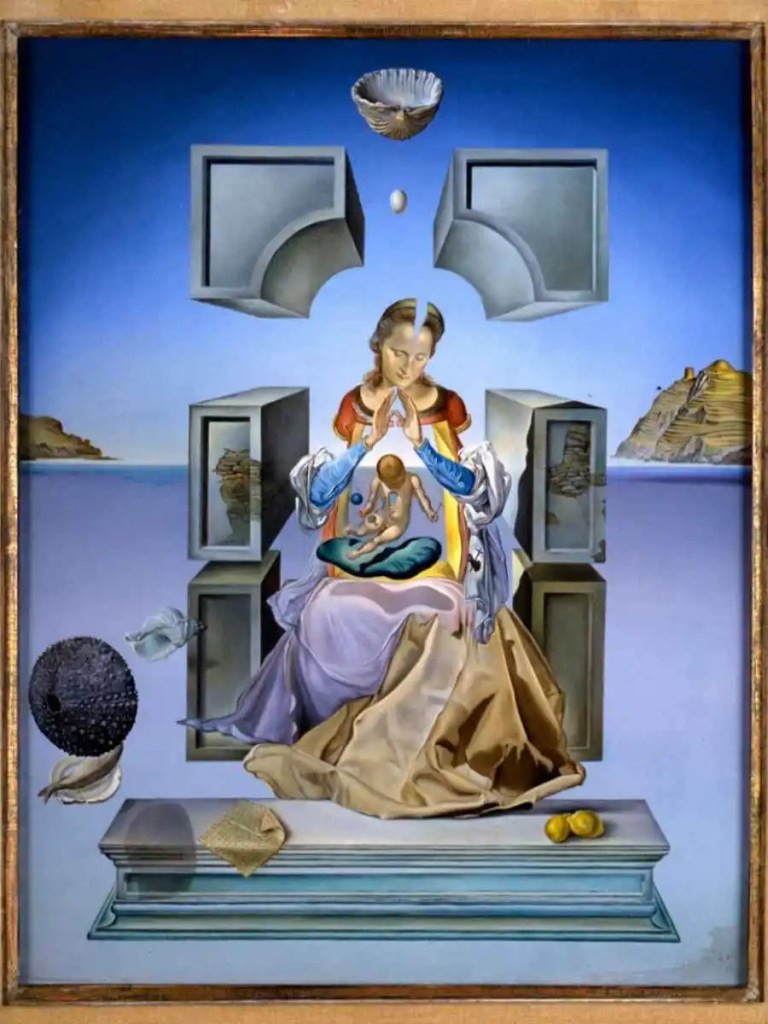
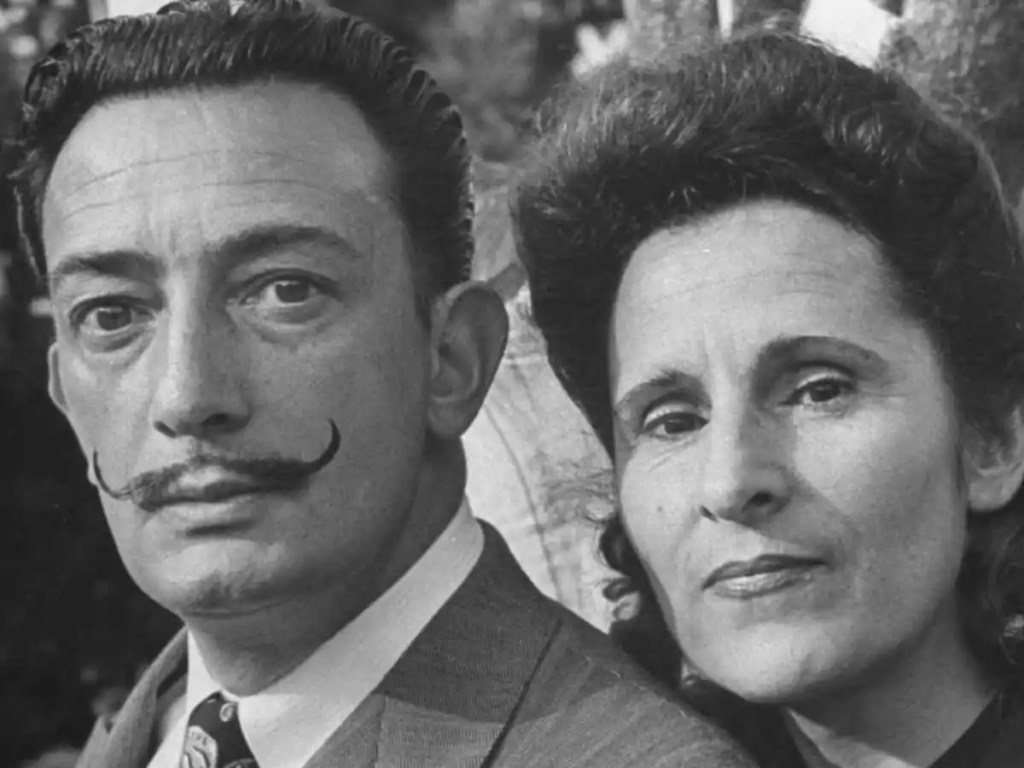
Salvador Dalí was born in 1904 in Figueres, but he lived a large proportion of his life in Cadaqués, a town on the coast near the border with France. He received his fine art training in Madrid and gradually became more interested in Cubism and avant-garde movements, joining the Surrealist movement in 1929, before painting possibly his most popular work, The Persistence of Memory in 1931. He lived in France for a while before immigrating to the US in 1940 where he finally achieved the global status he craved. Dalí married his wife Gala, who was ten years his senior and had previously been married to poet Paul Éluard, in 1934, and she became both his muse and ‘manager’, ensuring his work achieved the fame and recognition that it deserved. She is the subject of many drawings and paintings at the museum and these really caught my attention, their fine detail conveying his love for her in every brush stroke (as seen in La Madone de Port Lligat, below).
Dalí was involved in all aspects of the museum’s construction. The building was originally an old theatre, which the artist knew as a child. It had suffered a major fire during the Spanish Civil War and, in a state of ruin, the town’s mayor decided that it would be rebuilt and dedicated to Dalí and his work. Opened in 1974, it expanded during the 1980s, and now displays the single largest and most diverse collection of works by Dalí, mostly from the artist’s personal collection.
The museum is filled with all sorts of artistic paraphernalia, seemingly anything that captured Dalí’s wild imagination; sculptures, collages, mechanical devices, furniture, including the renowned custom sofa that looks like the face of American actress and singer Mae West when viewed from a certain spot, and there is also a collection of works by other artists. A glass geodesic dome cupola crowns the stage of the old theatre, and Dalí is buried in a crypt below the stage floor.
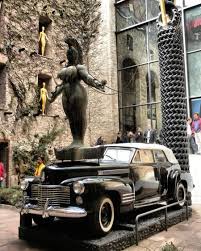

My favourite exhibit is the ‘Rainy Taxi’, also known as ‘Mannequin Rotting in a Taxi-Cab’ which was created in 1938 and was first displayed in the Galerie Beaux-Arts in Paris at the Exposition International du Surréalisme. A full-sized car, a Cadillac Series 62 convertible, is parked in the theatre’s courtyard. In it, a male chauffeur complete with the head of a shark is in the front seat, whilst a female passenger sits in the back seat, wearing an evening gown with coiffed hair, as live snails crawl around her body. The most disturbing facet, and it’s this that I recall vividly, is the rain (or water) falling inside the car, generated by a system of pipes, offering the ultimate claustrophobic ‘state of panic’ for its occupants.
It’s this ‘unsettling’ feeling that pervades Dalí’s works, that constant questioning of many previously ‘accepted’ parts of our lives, that I find compelling. Bizarre and intended to both intrigue and shock, his work turns on its head what we thought we knew. His brazen confidence and, possibly dare I say it, arrogance, is intoxicating.
How did this affect my work? I found myself gradually drawn to Surrealism: other artists such as René Magritte, Max Ernst, Joan Miró, Man Ray, and Frida Kahlo became of interest and this led to discoveries in music such as composers Erik Satie, George Antheil, Andre Souris, Francis Poulenc and John Cage, all of whom were also deeply inspired by this movement.
Such a profound influence can also help us to question musical interpretation too: not necessarily the actual interpretation itself, but ultimately enticing us to question ‘why’ we do things in a certain way.
This ‘influence’ didn’t happen overnight. But after a period of time, I realised how this experience had affected me and opened my mind to many possibilities. I’m therefore mindful to encourage my students to embrace all art forms, and, indeed, all such experiences, so that they emerge as more rounded human beings as well as critical-thinking individuals.
Only a few years after my visit, Dalí tragically suffered a devastating house fire at Pubol castle, one of the homes that he had shared with Gala. The injuries he sustained as a result of the fire dictated that he remained in a wheelchair for the rest of his life and he died a few years later in 1989 at his apartment at the Theatre-Museum. Thankfully, he has left us with much to enjoy.
Find out more about Dalí’s museum by clicking on the link below:
Top Image, the external façade of the museum: photo by Olesia Libra on Unsplash

Wonderful post, and a great reminder of all the ways other art forms feed our own. Thank you!
Thank you so much, Rhonda!