
This is the final post in pianist and professor Julian Jacobson’s series examining the ‘Hammerklavier’ sonata in preparation for his lecture recital on Sunday January 11th at Mill Hill Library in London. In this article, Julian explores and examines some of the pressing preparation issues found whilst working at this epic piece.
Purchase your tickets for the concert by clicking here.
In my final post I’m going to talk about some of the issues and problems involved in preparing and performing this most epic of piano sonatas. Some of these are well known to anyone with more than a passing interest in the piece and have been argued this way or that for at least the last hundred years.
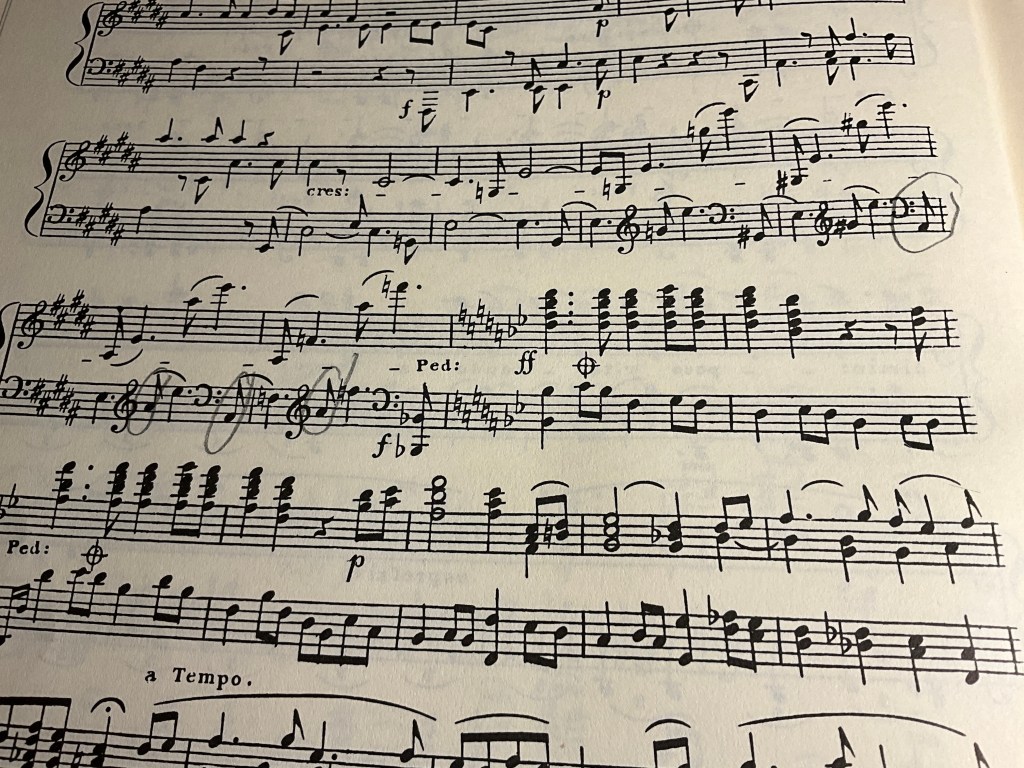
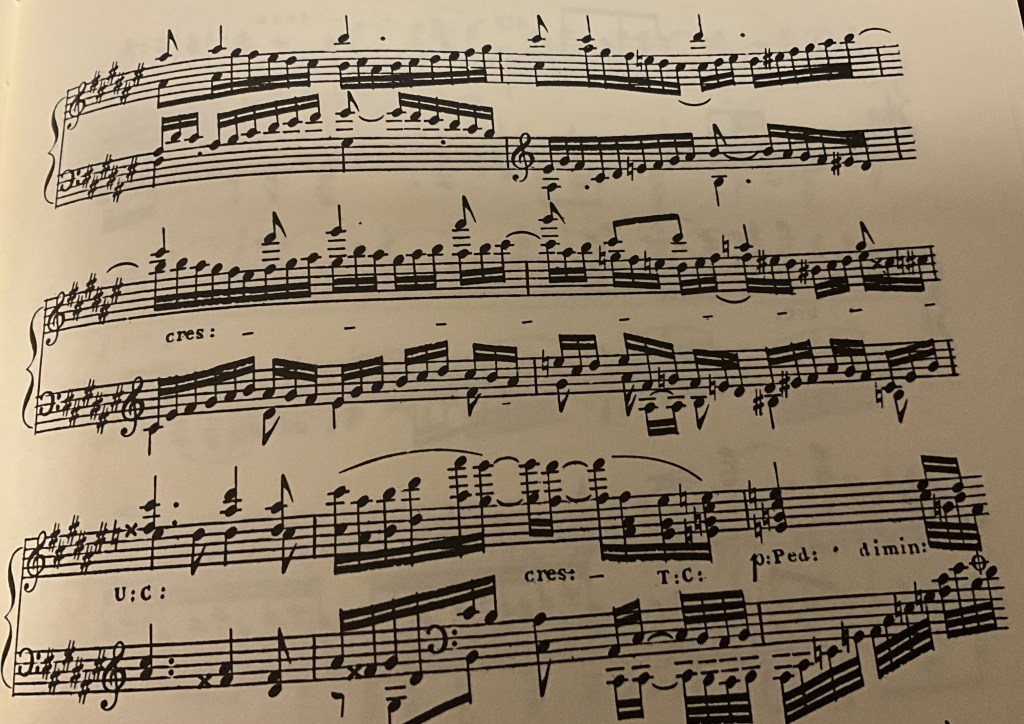
Speaking just of the text itself, it’s a catastrophe that the autograph manuscript has disappeared so that there are many details that we only have the early editions to rely on. The most notorious example is the famous A sharp/A natural dilemma in the lead back to the recapitulation of the first movement, perhaps the single most disputed note in all classical music. To give the merest sketch of the argument, to which Jonathan Del Mar devotes some 70 lines of dense argument in the new Bärenreiter edition: at bar 201 Beethoven has suddenly changed the key to B major (though inscrutably he uses only two sharps, as if it’s B minor, till bar 214 when he changes to five sharps). From bar 221 there’s a crescendo and a new harmony every bar. Two bars before the return of B flat major for the recapitulation, he writes what has often been assumed to be a fairly regular modulation, A (natural)-E and A (natural)-F natural. The trouble is that there is no sign in the sources of the necessary natural sign against the A’s which theoretically should therefore be A sharps. When played like this it gives one of the most bizarre harmonic progressions in all of music, and it also presupposes that Beethoven would have written the interval of a fifth as A sharp to F natural, rather than changing the A sharp enharmonically to B flat.
Yet it cannot be completely written off. To approach the home key of B flat by being already in, or on, the tonic, rather than from the dominant, has a precedent in the first movement of the 4th Symphony, moreover in the same key. It’s thrilling to suddenly burst out in the home key without having any idea how one got there, and the more “normal” version with A natural can only sound a bit flat once one has got used to A sharp. And so this is the only place in the whole of music where I play a note which I believe is almost certainly “wrong”. It has even been said that if Beethoven had had the “omission” pointed out to him he might have been delighted and kept it!
Plunging into the first movement itself, the very opening presents a challenge which pianists, great and small, have addressed in numerous ways. At the very outset one is asked to leap with one’s left hand alone from a single bass B flat to a chord two octaves higher, on a single quaver beat at a fast alla breve tempo. There are pianists who grandiosely stretch out the quaver to a ponderous crotchet, but this cannot be right when the theme is supposed to show the motto “Vivat vivat Rodolphus” (Archduke Rudolph, the sonata’s dedicatee and Beethoven’s most important patron). Consequently many, perhaps most pianists take either the upbeat quaver or the first chord with the right hand. But perhaps here one should remember Artur Schnabel’s motto, “Safety last!”
Another issue is the improbably, dangerously fast metronome marks, especially for the first and last movements. This is the only sonata for which Beethoven gave metronome marks, so we feel that at the very least we should try them out. But the outer movements are then so fast that they are in danger of sounding either too “virtuosic”, without room for the many beauties of the first movement, or too fast to give real clarity to the fugal writing in the finale. Thus many of the greatest pianists have modified the tempi to something well beneath the printed speeds. Yet the first movement was said by Czerny to be “uncommonly fast and fiery”, so one needs to avoid a sort of Brahmsian grandeur resulting from too slow a tempo. As for the visionary fugue – how to begin to arrive at an interpretation? With the virtually impossible marking of 144 to the crotchet, I think it needs a tempo of maximum 120 if it is not to sound like some implacable, abstract machine (or simply messy). Recently I’ve taken to imagining how Gustav Mahler – a virtuoso pianist in his youth – might have played it and finding that – if I’m remotely right in my imaginings – it can take a fair amount of freedom. We have very little contemporary evidence to draw on, since the sonata remained unperformed till Liszt’s famous Paris performance in 1836, and in later years Liszt is said to have sometimes taken much broader tempos.
The middle movements present fewer problems: 80 to the bar is only a little too fast for the explosive, parodistic Scherzo (pre-echoes of Mahler again), and 92 to the quaver is only a little cramping for the profound, 17-minute Adagio sostenuto. “Appassionato con molto sentimento” is the marking, and it should not sound as if it’s being played in a catatonic trance, as it does in Glenn Gould’s almost 21-minute traversal. I take my bearings from the great Adagio of Mozart’s A major Concerto K488, in the same tragic key of F sharp minor and with the same wonderful use of the “Neapolitan” key of G major. Beethoven has rarely been more operatic than in the second theme of this movement, and I think it’s in that spirit that we should try to recreate it!
There are many other points I could go into but perhaps I will end by pointing out a not-often noticed influence on the teenage Mendelssohn, writing his miraculous Octet in 1825 when Beethoven was still living and only seven years after the Hammerklavier. Mendelssohn had already paid homage to Beethoven in two of his early piano sonatas and the Op 13 String Quartet. In the Andante second movement of the Octet, the delicately intertwining scales of the second subject are surely directly modelled on Beethoven’s Adagio at the continuation of his second subject (from bar 54): imitation here certainly being the sincerest form of flattery!

Finally, if preparing the Hammerklavier, it must (except I suppose in the Adagio) feel like fun, and not like an insuperable challenge. I’ve been guilty of that myself in the past, referring to it as the “Jammerklavier” (misery-piano). If you want to play it, give it plenty of time but then enjoy the physical exhilaration of Beethoven’s most daring piano writing, and the ultimate triumph of his musical and spiritual message.

Image credit: Roger Harris

Hello Melanie.
I once again enjoyed this blog. How challenging and demanding it must be to perform Beethoven’s works as faithfully as possible, and to try to understand what his intentions were in the score. And, for instance, how frustrating it must be not to know whether a note should be an A or an A sharp or whether it was deliberately notated incorrectly. 🙂
Fortunately, as a pianist there is a certain freedom to interpret the music and to convey it as convincingly as possible, and Julian Jacobson has dared to take on that challenge. Thank you very much for posting !
Hi Martin, that’s all great to hear. Yes, this piece is exceptionally demanding and it’s good to know how Julian makes his decisions regarding interpretation. 🙂