
My final guest writer of the year is pianist and piano professor Julian Jacobson, who is no stranger to my blog having written several guest post series already. This mini series focuses on Julian’s forthcoming performance of and lecture on Beethoven’s mighty ‘Hammerklavier’ Sonata No. 29 in B flat major Op. 106 on Sunday January 11th 2026 from 5.00pm – 6.30pm at the Mill Hill Library in London. Find out more and purchase your tickets by clicking here.
First the title: composed in 1818, it was published by Artaria in 1819 in two separate editions, identical except that one had the French title “Grande Sonate pour le Piano-Forte” ( just in case anyone thought of trying it on the harpsichord…), the other the German “Grosse Sonate für das Hammerklavier”. A Hammerklavier is simply a keyboard-with-hammers, i.e. a piano, so that every piano sonata that has ever been written is in fact a Hammerklavier sonata, including let’s say Mozart’s ‘Sonate facile’ or Schubert’s little A major (although those two certainly couldn’t be designated as “grosse Sonaten”).
Enough of semantics. Op 106 IS the Hammerklavier for all time, the mightiest of all sonatas and consciously written to be his greatest. Its titanic opening – Beethoven’s only sonata to open fortissimo’, in fact he usually starts P or PP – already sounds and feels like hammering on the keyboard. Generally weighing in at between 45 and 50 minutes, it is twice or more the length of most of his sonatas: its nearest rival, op 7 (when the young genius was spreading himself luxuriously) is some 20 minutes shorter.

It consistently features in lists of the most difficult solo piano works ever written, out there with Scarbo, Scriabin 5th Sonata, the wilder Ligeti Etudes and even the maniacal Opus clavicemalisticum of Sorabji. Of course its difficulties are of a different nature to the 20th century examples, being mainly the result of an unprecedented expansion of classical language and technique, with massively orchestral writing in the first movement (leading directly to Liszt) and the finger- and hand-busting ten-minute fugue that serves as Beethoven’s finale – our own “Grosse Fuge” to rival the string quartet one, the original finale of the op 130 string quartet, which Stravinsky thought was the greatest piece of music ever written and “modern forever”.
Talking of Liszt: the sonata had been thought to be unplayable until Liszt deciphered it and performed it in a concert at the Salle Érard, Paris, in December 1836, to a select audience including Berlioz who wrote a famous review, praising Liszt’s command and his absolute fidelity to the printed text. Liszt then kept it in his repertoire, apparently often stretching out the tempi to emphasise its majesty and showing us that, despite what many pianists say and attempt (starting with the semi-disastrous Schnabel recording), we should feel no obligation to take Beethoven’s almost impossible metronome marks for the outer movements too literally. Nevertheless to convert the first movement’s heroic two-in-a-bar athleticism into a ponderous, ‘maestoso’ four-in-a-bar, or the visionary energy of the fugue into a comfortable rerun of Bach’s B flat Fugue from book 1 of the “48” (with which it has much in common) is surely to fundamentally misrepresent them.
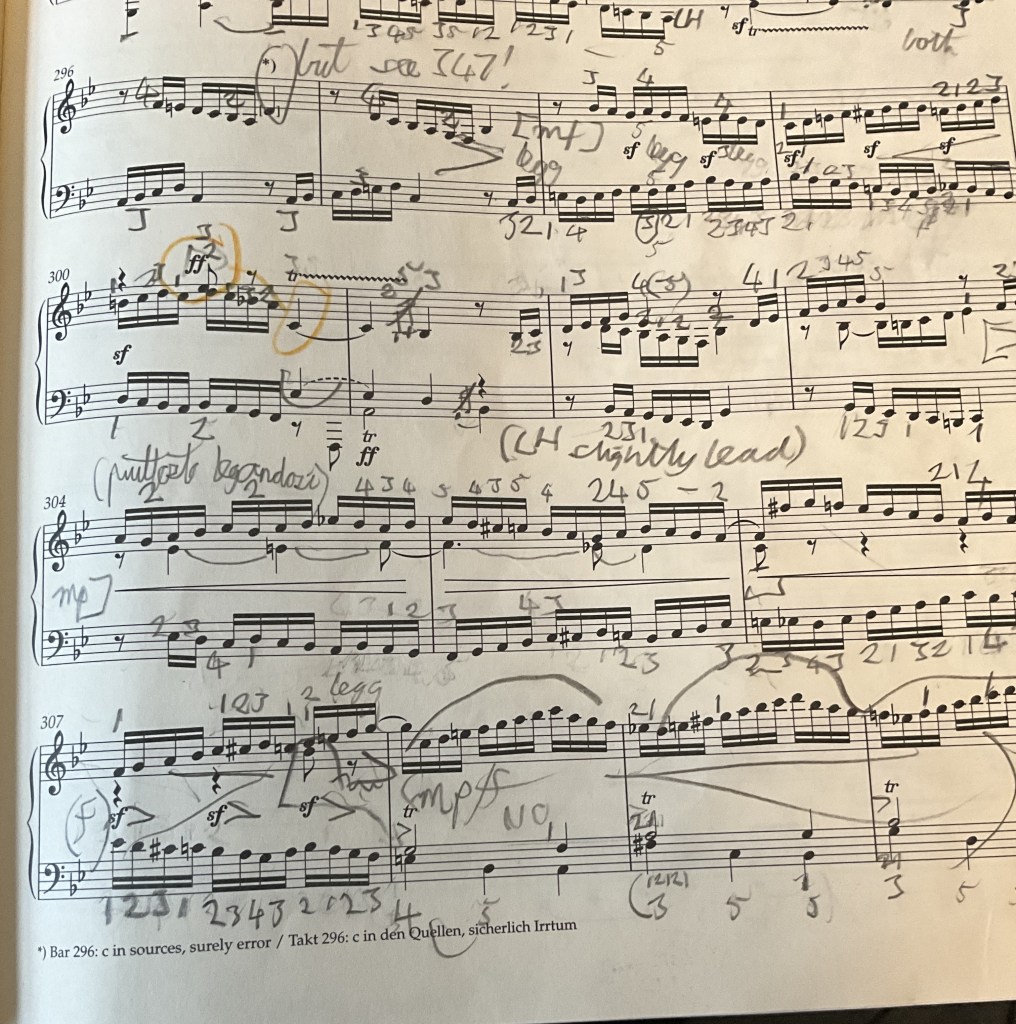
In future posts I shall go into my own relationship to the sonata and into some analytical and technical details, also into some famous and infamous problems with the actual text. The autograph manuscript has never been found and it’s been estimated that if it ever did it would fetch a record sum for musical manuscripts, well into seven figures. Then we might FINALLY know if it’s A sharp or A natural!

Image credit: Roger Harris
Top image: Beethoven (around 1801) painted by Austrian historical artist Julius Schmid (1854 – 1935).
