
Pianist and teacher Julian Jacobson has written this post which marks the fourth in a series dedicated to the piano concerto composed by his mother Margaret Lyell. Julian will be performing the piece tomorrow night in Birmingham: to find out more and purchase your ticket to this event, click here.
And so the abstract score becomes physical reality. Two rehearsals so far, sadly not with the full orchestra yet (I’m dying to see how her meaty trombone writing sounds), but enough to see that, as well as her gift for melodic writing and late-Romantic harmonic lushness, she had an ear for sensitive wind writing. In particular, the oboe and horn are used in a semi-concertante manner, duetting with the piano in the more lyrical passages. The string writing is adequate but perhaps a little thin and I might exercise filial rights and fill it out a bit before publication! The piano writing itself is entirely idiomatic, with an unfailing ear for voicing and spacing, not quite virtuosic but with rich textures, indicating that she was no mean pianist for a 2nd-year student.
“Watered-down Grieg my dear” – thus she related Sir Henry Wood’s reaction, I suppose a typical male chauvinist remark for the period. Indeed it opens with a timpani roll, crescendo to crashing chords on the piano in C minor, the home key, which can hardly fail to evoke the opening of the Grieg Concerto – maybe she had been playing it. But the language is much closer to Rachmaninov of the 2nd Concerto, then less than 30 years old and recorded for the first time (by Rachmaninov himself, with Stokowski) in the very year (1929) in which she composer her piece! I inherited from her the bulky box set of 78s of the famous recording, and I imagine her sitting in her student bedsit listening rapturously to the sumptuous sounds. Imitation being the sincerest form of flattery, it’s not surprising that there are strong echoes of Rachmaninov’s first movement in her piece, including a soaring, warmly lyrical second subject in the relative major key E flat.
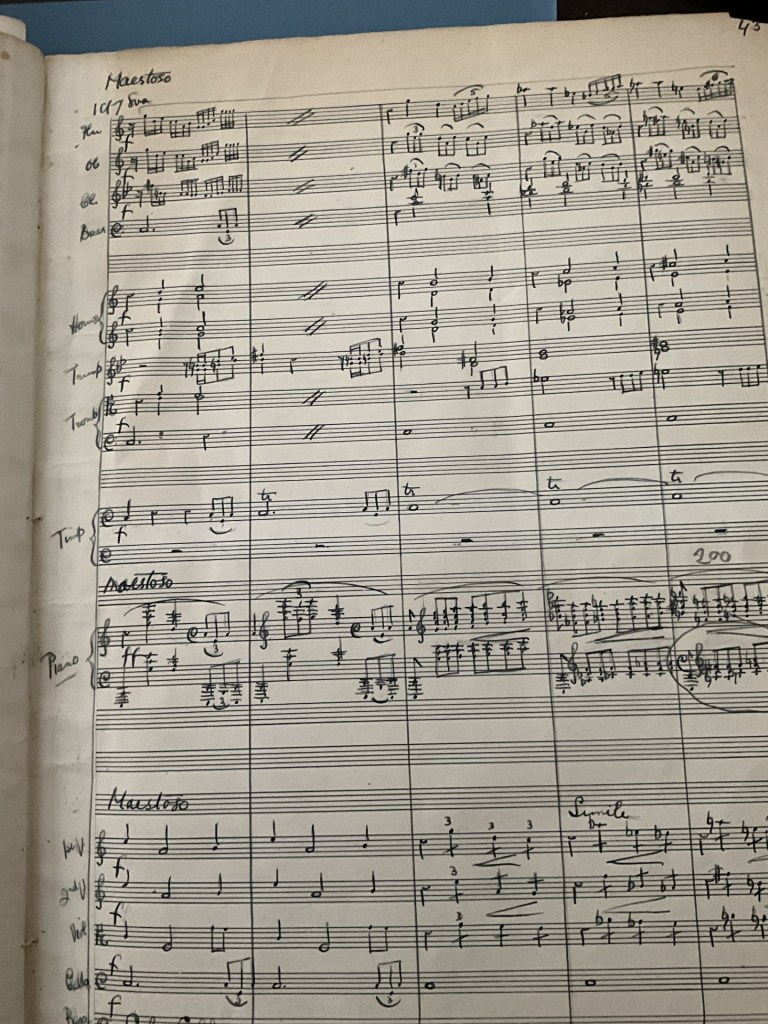
Is there any particular musical depiction of the mountain of the title, or any specific Scottish colouring? The opening certainly evokes the grandeur of Schiehallion. One would search in vain for any folkloric music – never her thing – but the faster, dancing music that followed on from the highly Romantic second subject and recurs in the development section has a certain Scottish flavour somewhat like Hugh Roberton’s ‘Songs of the Isles’. There is room for two short but effective cadenzas, and the piece moves towards a grand peroration, bringing back the opening ‘Largo maestoso’ theme now in triumphant C major – another Rachmaninov echo, although virtually every Romantic concerto that starts in a minor key concludes in the major!
Finally – googling ‘Schiehallion’ a few days ago I was delighted to discover that it’s also the name of a premium Scottish lager from the Harviestoun Brewery. I was just in time to order a case for the post-concert celebrations. I know my mother would have approved – and I’m sure the trombonists are going to be very happy!


It promises to be an extraordinary concert. I truly wish I could be there, or that a recording would be available of the concerto. What a loving journey this has been!
Hi Barbara,
I’m also hoping that there will be a recording made available of the concerto which will allow me to share it here. Stay Tuned! 🙂