
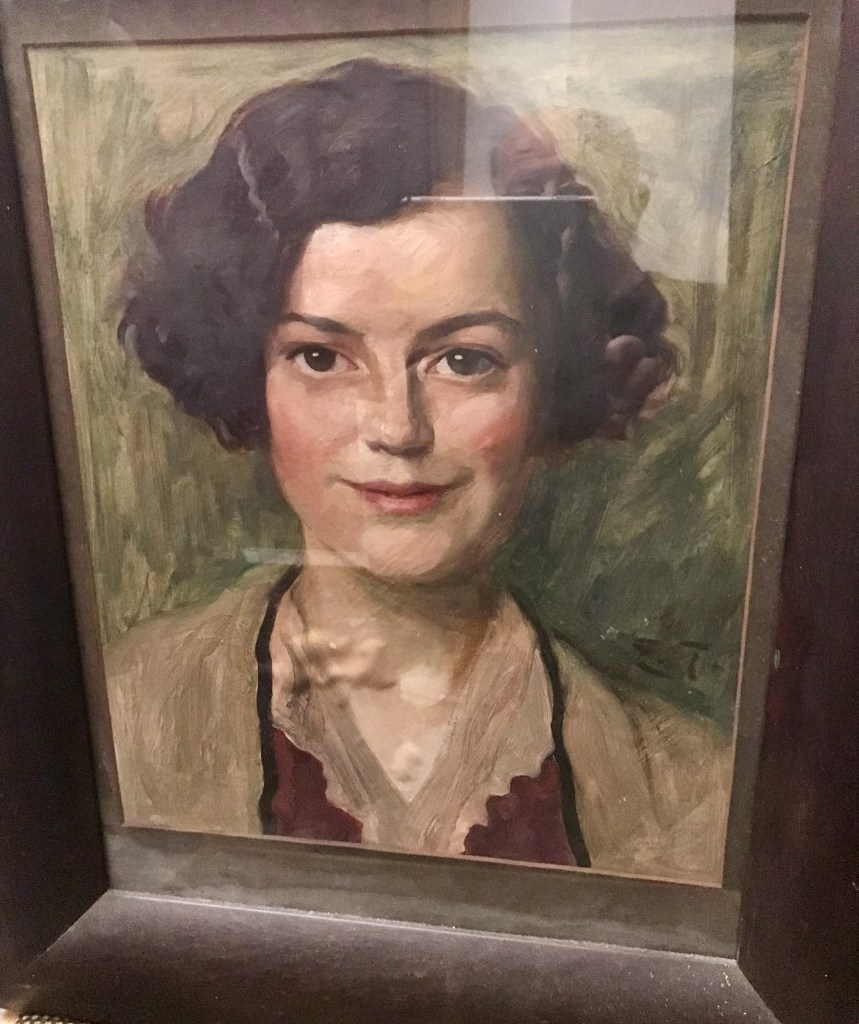
Pianist and teacher Julian Jacobson continues this series focusing on his mother’s music (pictured above), and specifically her piano concerto which he will be performing on May 30th at the CBSO Centre Birmingham with the Romantic Revival Orchestra and conductor Tommaso Nista. You can purchase your tickets for this concert by clicking here.
In this post Julian writes about the breadth of his mother’s music.
It’s now time to examine my mother Margaret Lyell’s music in a little more depth.
In addition to the “Schiehallion” piano concerto, from her student years at the Royal Academy of Music (1928 – 31) there is also a terrific Violin Sonata which Elisabeth Perry and I played at her memorial concert at the British Music Information Centre on 19th April 2001 – a joyous occasion filled with her family and friends. The Violin Sonata has the same youthful glow, fervour and warm melodic inspiration as the Schiehallion piano concerto: similarly it is in one movement, and could surely be revived at the present time when the battles over modern music have been fought and largely won (or lost, depending on how you look at it).
These are perhaps her most personal works. When, mainly after the war years and in the midst of bringing up three boys, she resumed composition, the craftmanship was more secure but some of the ardent daring of her student pieces was lost (the same has often been said of, for instance, Brahms and Schumann – not that I’m making a comparison!). Perhaps if someone had steered her towards a major, forward-looking teacher she might have developed into a significant twentieth-century figure. But it was a time when women were still not expected to be composers, and could become so only by the most pugnacious persistence and, mainly, by renouncing family life. Well, I’m grateful that she did not do the latter! But I often wonder how her composing might have developed if she had been born two generations later.
Meanwhile there is a wealth of charming and beautifully written music which falls into two main categories: choral music, mainly composed for amateur choirs, and children’s piano music. Among the choral works are:
– Three part songs for the male vocal group Cantabile, settings of Aesop’s fables. “The Shepherd Boy and the Wolf” was sung by the ENO Chorus at her celebration concert in 1984
– A lovely rose is sprung (words anon), for the Coliseum Carol Singers.
– Love in May, for the Rainham Ladies’ Choir (Roberton 1976)
– All seasons shall be sweet to thee (Samuel Taylor Coleridge, Curwen 1949)
– In Praise of Music (words and music), for the Linn Choir Glasgow (Curwen 1968)
– The breathing earth (words and music, Curwen 1949)
– Ballad of the farmer’s daughter (1990, Bardic)
– Love is enough (William Morris), for the Royal Wedding August 1981 (unpublished)
Her solo songs are less important and mainly unpublished, however there is a cycle of six songs, “Joys of Other Lands”, words by Marjorie E. Kirtley (Curwen 1951) which shows a more adventurous musical language. There is also a considerable amount of music from around 1960 for a projected new version of Hansel and Gretel for children which was never completed. There were also several songs for Stella Wright, chairman of the Massenet Society.
This isn’t a complete list and I’ll happily supply one to anyone who is interested!
Following the two student works, her instrumental music – while not exactly “educational” – is mainly aimed at children or non-professional pianists. The set “Random Fancies” (1949, Curwen), opens with her “hit” Whistling Sailor; the final number, “Foam Horses” thrilled me hugely as a two- or three-year old as I couldn’t believe anyone could play so fast. But her two best single piano pieces are “Rain in the Leaves” and “The Busy Street” (both Curwen 1957). The latter was an ABRSM choice for Grade 5 in 1961 (it would probably be Grade 6 now): a colleague to whom I once casually played the opening thought it might be by Stravinsky!
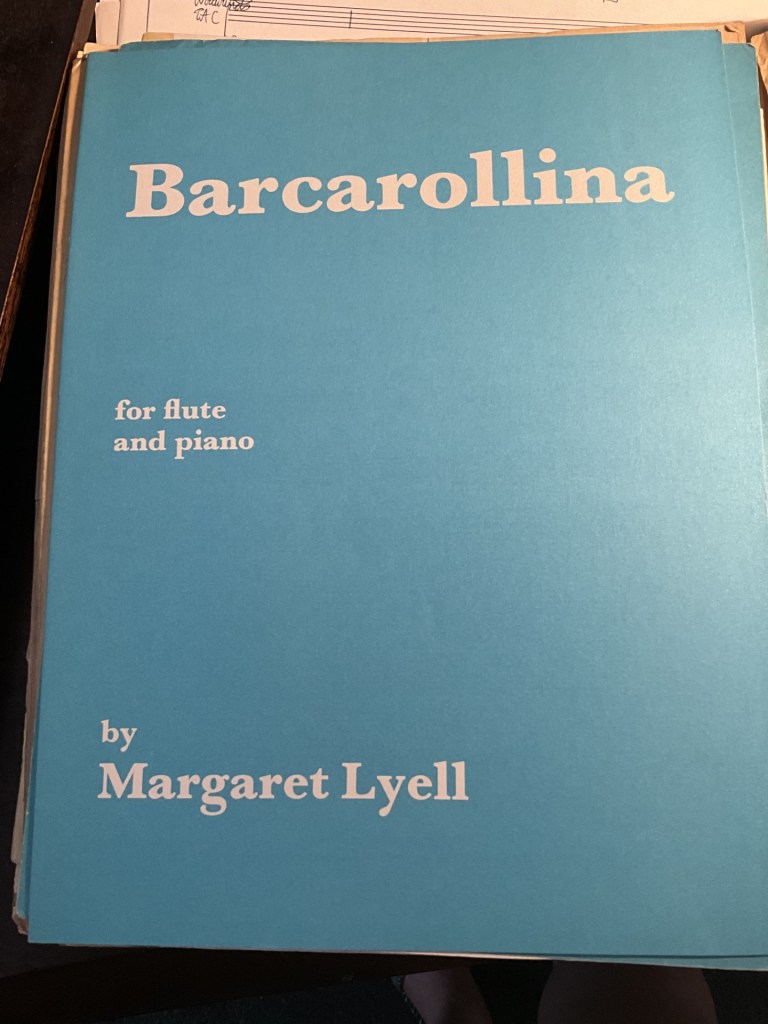
This leaves only a charming late flute and piano piece, “Barcarollina” (Roberton 1979), written for Susan Lordon (wife of the composer Howard Skempton).


I think this shows the range of her sensibilities, particularly with regard to the poets she set (with some of her own words), as well as her range of friendships, showing the respect and affection she inspired.
In my last post I will write about the Concerto (Schiehallion) after it has had its first rehearsal and has been reawakened into physical sound!
Margaret Lyell’s article in The Lady Magazine


Thank you Melanie,
I enjoyed the article again.
It must not have been easy to find enough time for her family in addition to her musical composition time,
how did she manage all this………
But… she did it 🙂
Hi Martin, I’m so glad that you enjoyed this article. Yes, it must be really challenging to find time to write music when you have so many other things going on, but somehow she made it work! 🙂