
Finding the appropriate practice tool for a specific issue can be a matter of trial and error. When all the usual methods have been exhausted or perhaps overused, it’s time to try new ideas and find a fresh approach to nail that awkward passage.
Recently, I’ve been working with a couple of students who are both preparing Mozart’s Sonata K. 311 in D major. The first movement can be deceptive, with many rapid passages containing unforgiving twists and turns in the right hand particularly. Changing fingers at speed can be a major challenge for many. This is especially true during the trills. Although trills look similar, they require different fingering depending on the succeeding note patterns.
There are many ways to finger an ornament. Copious hand rotations or thumbs set under or over the hand often need a different practice regime. This ensures that fingers are literally programmed to play the pattern accurately every time. If this doesn’t happen, then hesitations or a slowing down (or destabilising) of the tempo may occur. Here’s a notorious spot for some (bars 35 – 36):
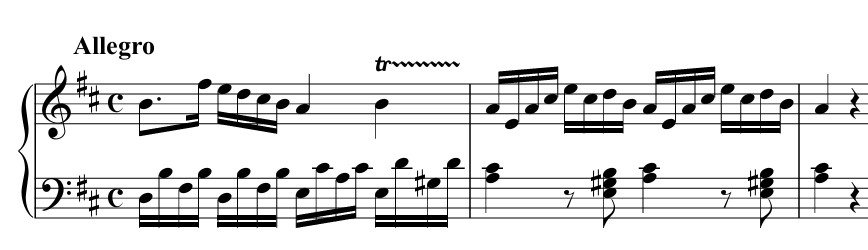
It’s the second time this trill appears (the first time is at bar 31) and the material following the ornament takes a different turn, than that after the first time, hence the unexpected finger change at the end, turning the hand over the thumb to play a second finger, which can sometimes upset the flow – the following is only a suggested trill interpretation:
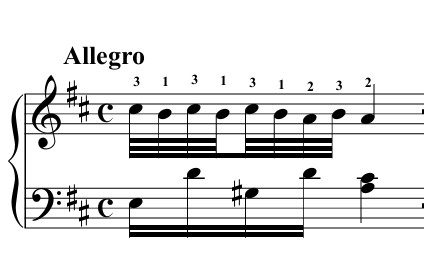
Here, I normally suggest applying many different touches (non-legato, staccato etc.) followed by different rhythms (dotted rhythms, triplet figures and the like), and a whole array of accents, as well as playing in various octaves around the keyboard. However, occasionally further detailed work is necessary.
This is when we turn to the repetition method. A successful ornament demands strong independent fingers; ones which will work very quickly, cleanly, and rhythmically. If trills are becoming sluggish, slower than necessary, or notes are not fully sounding or are unequal, try the following suggestion.
Repeated Note Exercise
The ornament must be isolated and taken out of context. Banish any sense of rhythm or pulse and just focus on the notes, working at the right hand. Start by playing the pattern in double notes. Follow this with triplets:
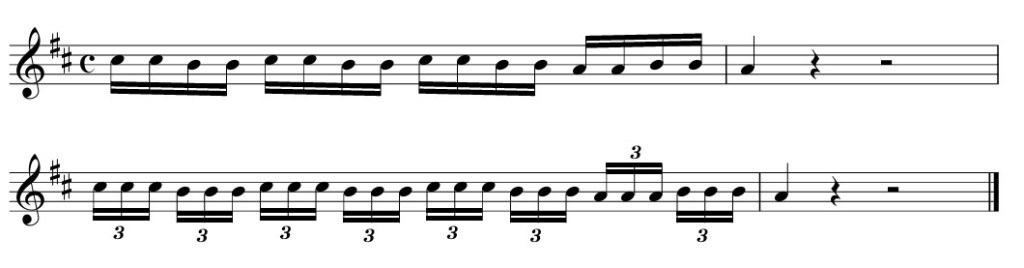
Finally, you could try playing four semiquavers per note. Make sure you use the fingers with which you will play the ornament. Always practice slowly to begin with and, most importantly, free from any tension. With this in mind, you may need to ‘bounce’ the hand after each note (at first), especially at the beginning of each beat in order to free the wrist so that it doesn’t ‘lock up’. This technique should be combined with a full ‘heavy’ sound on every note when played slowly.
Now experiment with accents. Start with one on the first beat of every group, then on the second beat. Follow this with accents on beats 1 and 3 of every note group for the triplet group. Add speed gradually until you can play quite fast and with a warm sound. Ensure each note is completely even tonally and rhythmically. Whilst you are not yet adhering to the pulse, the notes must still be equally played. You could also try using dotted rhythms on each repetition, whether two, three or four notes are being played.
Once you’ve mastered this, return to playing the ornament as written. Lighten your finger touch and, hopefully, the practice repetitions will enable an even trill (fingering, notes, rotations) with all notes clearly articulated and fully sounding. Try now to combine the trill with the left hand.
You might require a fair amount of practice to become familiar with the feeling of repeating the notes flexibly. Keep the wrist always free of tension. Ideally, it should move after every quaver beat, albeit imperceptibly. It might be beneficial to play the repetitions with the left hand semiquaver pattern. Do this at very slow speeds. This enables perfect placing of each note.
Repeating notes in a pattern can be successfully applied to all tricky passages and ones which combine both hands too. If there is a unison pattern of quavers or semiquavers, this may be a useful way to help coordination.
