
A very popular and beautiful piece from a set which Tchaikovsky wrote for children. ‘Sweet Dreams’ appears on List B of the current ABRSM Grade 5 piano exam syllabus. It is also on the Grade 5 piano exam syllabus for Trinity College London. As many will be preparing this piece, this article offers a few practice ideas.
Unashamedly Romantic in style, this little work allows pianists to unleash their expressivity, as it demands a full, rich sonority, measured rubato, and plenty of sustaining pedal. Tchaikovsky composed a set of 24 Easy Pieces (á la Schumann) in 1878. He clearly cited Schumann’s Album for the Young Op. 68 as the inspiration.
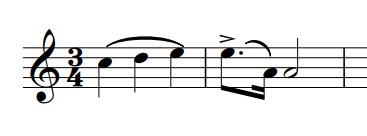
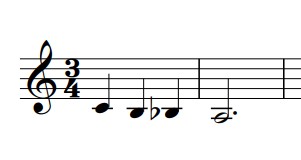
Set in the key of C major, there are three important musical strands or lines. The melody is often in the right hand or top line. The bass line outlines the bottom of the harmony, but it can occasionally contain the melody too. The middle part provides the off-beat accompanying chords. It can be helpful to work at each part in isolation. The following examples illustrate the three musical lines in the first two bars of the piece:
Top Line:
Middle Line:

Lower Line:
Start with the top line alone. Focus on developing a deep cantabile (or singing style) touch. Keep fingers hovering over the keys. Ensure connection between each and every note for a smooth, firm legato. There should be no sound ‘gaps’ between notes. Aim to use a relaxed or loose wrist to help ‘cushion’ the sound. This method will be most effective if you can use the weight of your arm behind each finger. This offers extra, much-needed finger power, which encourages the sound to ‘project’ above the accompaniment.
At bar 7 – 8, and elsewhere in the piece, there are two-parts to deal with in the right hand. These can be practised separately for a seamless join between notes. Try to keep the fingering the same as if you are playing the two-parts together. Finger substitution will be crucial everywhere. It involves changing fingers on a note. This allows for a whole phrase to enjoy a continuous legato touch. This method is exemplified at bar 9. Here, aim for a completely relaxed hand, so that the second finger can swivel swiftly into place, taking over from the fifth finger (a tense hand can make this manoeuvre much more difficult).
The left hand has a trickier time in this piece, but the two-parts can be worked at separately. Start by blocking out the left-hand:
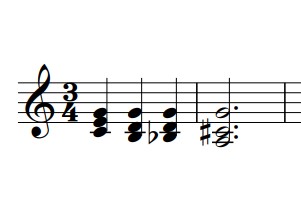
This benefits the quick learning of notes and fingerings. Next, work at the bass line and try to join every note as much as possible. When this is challenging, as it is in bar 4, use the ‘illusion’ of legato. This means keeping a note depressed for as long as possible before sliding to the next. Match the sound of the second note to that of the dying first note. This example shows bar 4 between beats 2 and 3, where the fifth finger will need to ‘slide’ quickly from the A natural to the G:
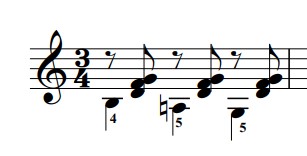
However, if you play the upper chord with the thumb taking the G and F, you could use the following fingering, which involves the fourth finger turning over the fifth; a move which does require a flexible hand and wrist:
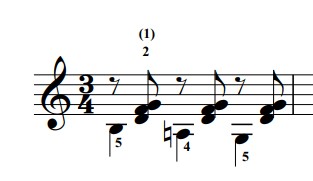
The off-beat inner chords in the left hand can also be practised alone. Work at them with a full sound, moving through each bar slowly, playing them as crotchet beats, that is, on the first beat of the bar. When secure, add the lower part. Balance the hand so that most of your arm/hand weight is focused on the lower part. The off-beat chords must all sound precisely together. They are much lighter and are gently added into the texture. These off-beat chords should ideally be softer. Aim for this softness when they appear in the right hand from bar 17 – 32. If keeping time proves a challenge, set the metronome at a quaver = 108 – 112. Try to ‘sit’ on the slow quaver beat throughout. ‘Place’ the off-beat chords carefully, so that you neither rush nor linger.
I would work at this piece with a semiquaver pulse, too, that is, dividing each crotchet beat into four beats, as this will help ‘place’ the semiquaver figure in the right-hand part in bar 2 – a figure which occurs throughout the piece:
You can gradually increase the speed. Then, relax the pulse to include rubato where appropriate. This is most effective at the end of every eight-bar phrase.
When you are confident playing hands separately, practice both together. Melody lines need greater colour and focus. This is especially true when both hands play melodic material simultaneously from bar 22 – 24. The same applies from bar 30 – 32. The left hand will require a deeper touch from bar 17. The music moves into G major and becomes more impassioned.
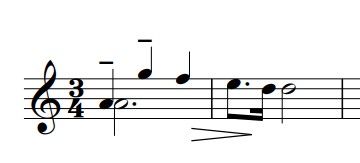
Phrases need careful shaping. The opening bar should ideally crescendo to the E on the first beat of bar 2. This note should be played with an accent and the sound must quickly die away on the semiquaver and minim A. Make the most of the larger interval at bar 5 and 7 and all similar in the right hand part, is important musically; despite the soft dynamic markings, slightly more weight on the first two notes (an A and G in bar 5) will proffer a ‘yearning’ quality, often a prerequisite in the Romantic style, as shown here with tenuto markings:
Aim for softer colours from bar 1 – 17, but the music intensifies during the repeated section. Focus on the second half of the piece, specifically bar 33 – 48.
Rubato (or taking time) must be tasteful, without phrases being too drawn out. Passages such as the last crotchet beat in bar 8, can slow up a little, preparing for the new phrase at bar 9. The last crotchet beat in bar 24 needs a similar leisurely pace, even if momentarily.
The sustaining pedal will add a wonderful resonance to the texture. It’s advisable to practice with no pedal at all until fluent. This helps to cement a truly smooth legato touch with the fingers. When learning to add the pedal, practice changing it on nearly every crotchet beat, with some exceptions such as bar 2 and bar 16 (which can be pedalled for the full bar). You might like to try a little flutter pedalling, as this prevents a complete bar of pedal from ‘drowning’ the melodic material.
When you’ve learnt the piece and are happy with it, then the fun begins and you can explore a wider range of tonal colour to create your own dreamy interpretation.
